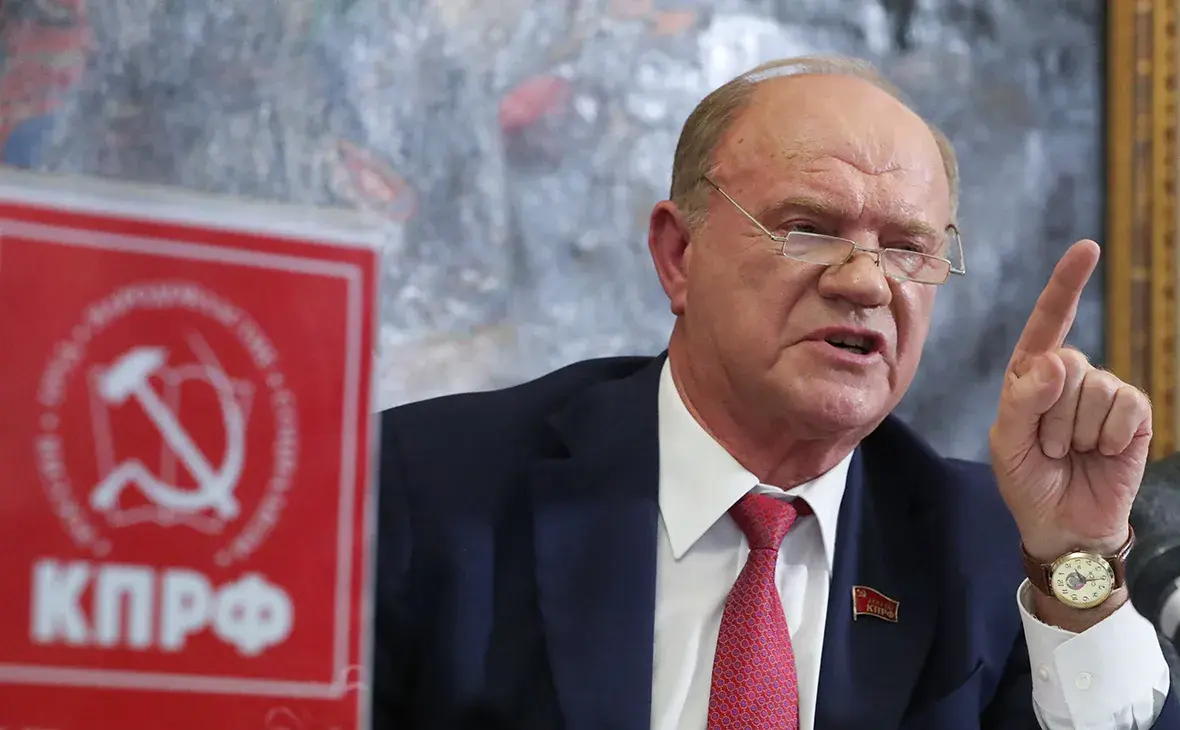
According to him, the country’s economy “hit rock bottom” in the first quarter, which could lead to a crisis.
Zyuganov also suggested that the situation this fall could resemble the events of 1917, when the communists came to power.
Video with English subtitles available here: https://bsky.app/profile/antongerashchenko.bsky.social/post/3mk3d7tu6m22v
A communist coup in Moscow would be a bit on the nose, but I’d allow it
Ill pencil it in for early October
Julian or Gregorian calendar? I want to get this right this time
Let’s go with Julian, and if not enough people show up that day we’ll go Full Greg.
No, you want that reversed, Julian dates are after Gregorian.
It’s not like last time where the Russian empire is caught up in a war of attrition in Eastern Europe… oh wait.
do they have policies? i’m genuinely interested
and the commie lemmings should review them
who? KPRF? not really, they are putinist puppets and controlled opposition
From what Ive heard there are genuine communist working underground in Russia.
“He emphasized that such a scenario must not be allowed to happen.”
Controlled opposition.
leader of a communist party warns against starting a communist revolution
mrw

Sounds to me more like a nudge nudge, wink wink sentence to avoid 25 years of prison in Siberia.
MLs are always controlled opposition (and always have been), just look at how quickly they team up with capitalists to take out any real socialists.
…such as?
Spain, Korea, Ukraine, the Soviets.
Any attempt at putting the workers in charge instead of the state is met with violence.
It’s not controlled in the sense that capitalist control them, it’s just controlled in the sense that the state requires private property & structurally state-capitalism is closer to liberal-capitalism, so you get less pushback from the cops, bureaucrats, bosses & other assorted middle managers that still get to live off labor of the workers.
I figured you’d mention Spain, but I’m not sure what you’re referring to in Korea. It was the Americans and South Koreans putting down workers uprisings there. As for Spain, the Anarchists weren’t ever going to manage to beat the Nationalists.
What you’re failing to understand is that in the context of imperialism, and the imperial boot, such decentralized anti-authoritarian revolutions are impossible. That’s why none of them ever worked, while all the revolutions that succeeded had to take measures to ensure their survival. Look at Poland and Solidarnosc - an anti-authoritarian labour movement, ergo a good thing, right? Except the result wasn’t liberation or socialism, but another loyal member of the imperial core, happy to help keep the boot of capital on the necks of the world proletariat.
If you guys ever manage to get off the ground and get a workers’ federation going, I’ll be the first to support you, and if you have to make a secret police to suppress the counterrevolutionaries, I’ll keep my atodasos to a minimum. In the meanwhile, Marxism-Leninism is the only thing that’s ever worked.
Man pick up a history book, you might learn something.
https://en.wikipedia.org/wiki/Korean_People's_Association_in_Manchuria
As for Spain, the Anarchists weren’t ever going to manage to beat the Nationalists.
Lol, as if the betrayal by the USSR didn’t decimate both the troops and their moral.
Except the result wasn’t liberation or socialism, but another loyal member of the imperial core, happy to help keep the boot of capital on the necks of the world proletariat.
Lol, it was just switching one imperialist capitalist boot for another. You have to be real stupid to consider the USSRs treatment of Eastern Europe as anything but imperialism.
Or it’s treatment of workers as anything but capitalism, just capitalism managed by the state.
Marxism-Leninism is the only thing that’s ever worked.
🤣🤣🤣
Yeah China will be socialist any day now 🤣🤣🤣
Why isn’t the USSR on any maps anymore?
How come Vietnam is liberalizing?
Some good points, but your inappropriate “lols” and hysterically laughing emojis are tiresome, especially considering the topic
The USSR’s treatment of eastern Europe was characterized by a net outflow of resources from the USSR to the Warsaw Pact, and within the USSR from the RFSFR to the other SSRs. In fact, a large part of the dissolution of the USSR was that Russian nationalists didn’t want to share that wealth. This was very, very different from capitalist imperialism in which wealth is extracted from the periphery.
Once again, I ask you what libertarian socialists have ever achieved. Have they ever acted as a geopolitical counterbalance to the US? Did they beat the nazis? Did they ever raise the literacy rates and raise the workers and peasants out of poverty? No, because they’ve only ever controlled a small region within one country during a civil war, and usually ended up losing. Come back to me with some concrete achievements, otherwise you’re just a useful idiot for imperialism.
Did they ever raise the literacy rates and raise the workers and peasants out of poverty?
Litterally yes, not just in Spain, but also in Korea & Ukraine then the MLs betrayed them and gave the farms back to the owners, because authoritarian “socialism” only exists to replace capitalist oppression with state regulated capitalist oppression, because it’s more paletable to the capitalist class, that’s why they’re happy to collaborate with them, to put down any sort of independent worker movement.
MLs = Marxist-Leninist?
Yup
Haha I’d never heard that take before. I’m curious about two things. 1) How do you define MLs? 2) What would real socialism entail? I’m guessing with those answers I should have a good idea what you’re talking about.
-
Anyone who self-identifies as an ML, such as the part mentioned: https://en.wikipedia.org/wiki/Communist_Party_of_the_Russian_Federation
-
Workers being in control of the means of production, like actually not in some “the party represents the workers BS”.
- cooperatives & unions control job sites - real unions not yellow unions
- workers control the economy via some real mechanism not 1 party elections with per-determined outcomes (Could be state-less - e.g Anarchy, could be state-full e.g some form of democratic socialism, will probably be a mix of both)
- the people that work farms control them and are not forced to give back the farms to capitalists like the USSR did in Spain.
Hell yeah💪. I personally agree with how you define socialism. I’m a reddit refugee lol. They are all LMs and Stalinists over there.
TankieJerk was a fun sub at least.
their definition of socialism is just market socialism.
-
Maybe, but I don’t think that the conditions are nearly as bad as they were in 1917. They’re obviously worse than they would have been had Russia not entered into the war, but the collapse in 1917 was due to urban food shortages. I don’t mean “luxury X is unavailable”, but that people couldn’t get staple food to survive because of demands of the war.
https://www.smithsonianmag.com/history/russias-february-revolution-was-led-women-march-180962218/
Like the French Revolution in 1789, a bread shortage in the capital precipitated unrest. After long shifts in the factories, female factory workers stood in bread lines alongside other women including domestic servants, housewives and soldiers’ widows. In these bread lines, news and rumors about planned rationing spread. When Saint Petersburg municipal authorities announced on March 4 that rationing would begin ten days later, there was widespread panic; bakeries were sacked, their windows broken and supplies stolen.
As he had throughout the previous months, Nicholas once again underestimated the extent of the unrest and again departed for military headquarters more than 400 miles away in Mogliev, which is now in Belarus, against the advice of his ministers. In the czar’s mind, leadership of the military took precedence during wartime, and he was concerned by the mass desertions occurring in the aftermath of munitions shortages and defeats at the hands of the Germans.
Though in past moments of revolutionary sentiment, the military had stood by its czar, by 1917, the armed force was demoralized and sympathetic to the demonstrators’ cause. The presence of large groups of women among the demonstrators made soldiers particularly reluctant to fire on the crowds. When the soldiers joined the demonstrators, as opposed to firing upon them, the end of the Romanov dynasty was near.
https://www.bbc.co.uk/bitesize/guides/ztyk87h/revision/5
There was a severe lack of food in Moscow and, in 1917, Petrograd only received half of the grain required to feed its citizens.
Now, okay. It’s possible that standards for political support are different, that the bar has changed. But the public in Russia of 2026 — though it may be in a worse state than Russia of 2020 due to resources consumed by the war — is also not experiencing the degree of deprivation of Russia of 1917.
This is consistently true of most revolutions. Once a lot of people are staring at the possibility of starvation you hit critical mass on people with nothing to lose.
That is definitely true, but 21st century examples of revolution don’t necessarily need a food shortage to begin (Maidan, Nepal, etc.)
I’m no historian but I think self-determination is up there with starvation as a common cause for revolt. But Russians wouldn’t be throwing off the shackles of a foreign empire.
It’s true. Looking back on revolutions, starvation is a common cause. What we haven’t seen is a relatively better off population revolt because their conditions got notably worse, from pretty good to pretty bad but not close to starvation.
Isn’t that party in Russia super pro-government? Essentially controlled oposition?
New boss is the old boss.
"we won the revolution!
now get back to work!"
Warns of the Risk of a Revolution in Russia
Isn’t it, like, his job to make this happen?
I’m pretty sure any real communists in Russia would be brutally repressed.
Oh, soviet union 2. Now with more soviets.
Soviet Union 2: Electric Bogaloo.
Electric Gulag-loo
Oops! All Commies
God damn, that was a good one!!
It’d be nice is Russia can take back itself from that dick-tater… Get rid of all of Putin’s ilk, elect a decent person as president., power wash the stench away, peace talks with their neighbors, condemnation of the US Pedo Party. All that good stuff.
Highly doubt it will happen.
Damn, I want that for the US!
Take it back to what, though? The 1990s? I guess that’d be an improvement. What they really need is progress. Is there any kind of progressive movement in Russia?
There was, but it was all stomped in the very beginning.
It would not be an improvement - do you have any idea how bad the 1990s were in Russia?
There’s a reason that Putin has high support, and it’s not all manufactured. It’s that the Yeltsin shock therapy was really traumatic - largest peacetime drop in life expectancy in recorded history.
Simpsons did it

Russian jokes still write themselves
In Soviet Russia, joke writes you!
Oh well. As a certain ballistic missile submarine Captain once observed: A revolution every now and again, is a healthy thing.
Good wipe Putin off the map
I support it. I have no love for the early USSR, but I see its fall as a historical tragedy
We’re gonna see that in the US before we see it in Russia. At least Russians have free education and free healthcare mandated by their constitution.
The levels of corruption there effectively means you have to pay to get decent service.
This sentence works for both of those countries
Communism sucks but even that would be better than Putin.
All communism?
Soviet communism was a disaster. Chinese communism works but is authoritarian. Israeli kibbutzes are pretty-much communism.
Ya forgot about Yugoslavias mixed system which also worked pretty well.
All communism?
Yeah, seems so.
Chinese communism works but is authoritarian.
From the POV of a communist I’m sure there’s a lot more in chinese communism to critique than just the authoritarianism. Like the existence of a billionaire class, private ownership of means of production, lack of independent labor unions, pretty high income inequality, market economy, and pretty western-looking consumerism. I mean it’s pretty much like USA if USA only had one political party.
I’m not advocating for the Chinese approach or for communism at all. My point about China is that it has improved living standards (pretty spectacularly) while others have failed.
If I could choose anything it would be like scandi-social-democracy, but with stronger controls on corporate and personal greed. I’d make hoarding wealth while others suffer socially unnaceptable.
“Socialism with Chinese characteristics” is just capitalism with extra steps and a red paint job.
If you’re talking about the Mao Zedong era, that was also a disaster but at least they did try to run the country according to communist principles. They were just very bad at it.

Show the rest of the graph please.
GDP during WWII isn’t very helpful a statistic, especially considering the occupation.
I think they might have meant after 93, not WW2.
That’s an impressive level of disingenuousness.
lol