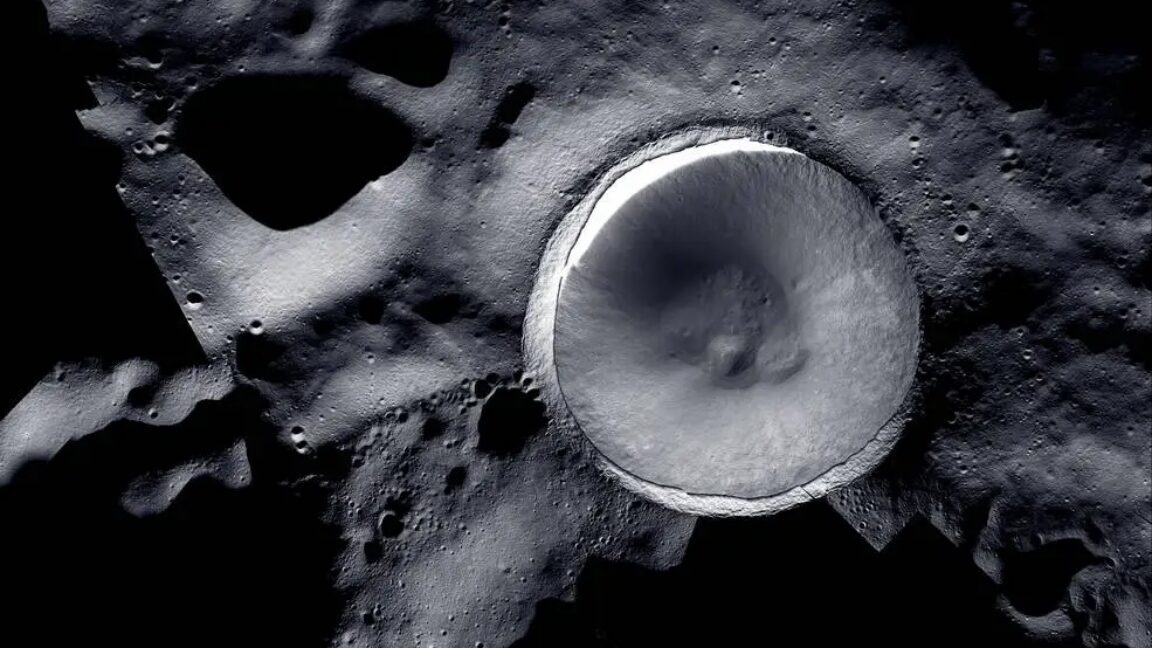
It’s unclear how China will use the win that would come from a successful Chang’e 7 mission, namely the visuals from its vehicles traversing the Moon’s South Pole. It has several options, one of the most intriguing being to claim that the territory explored by its rovers—establishing a keep-out zone for NASA.
That would be a clear provocation, but it could also further galvanize efforts in the United States to invest in Artemis and take the hard steps to accelerate its rollout. It would give Isaacman even more capital in his efforts to reform NASA.
One also suspects it may prompt people who do not view China’s efforts to “beat” NASA back to the Moon as a big deal to reconsider their position.
What threat?
From a propaganda standpoint, it will allow China to declare that it has not just caught up to the United States but surpassed it as this century’s superpower.
It seems like half the articles I read on this claims that only one side thinks it’s a race. Only one side has pride on the line.
Yet just like everything else we’ve handed to China and Chinese companies over the last few decades, our own idiocy and lack of focus is at least as significant of a cause as their rising economic capability.
Take EVs. People complain about Chinese companies stealing intellectual property, but I see the car industry has been outsourcing more and more across decades, and legacy manufacturers seem to have entirely given up on competing. Sorry not buying the excuses when you seem to do everything you can to throw away what advantages you started with
Fear mongering article that ends with such a bullshit scary idea:
one of the most intriguing being to claim that the territory explored by its rovers—establishing a keep-out zone for NASA.
The moon is recognized as a common heritage of humanity and is protected by a very robust series of international law established during the Soviet and American space race: https://en.wikipedia.org/wiki/Common_heritage_of_humanity
So the concern is the part of the moon everyone cares about is tiny. Previously it was easy to give other countries plenty of distance to do whatever they were doing. However now there’s a strong focus on places that appear to have exposed water ice, which is only a few craters near the South Pole. Suddenly the moon is tiny and we might be working elbow to elbow
While I agree it’s incredibly unlikely that China will attempt to claim sections of the moon at this stage, I think it’s been made pretty clear that international law isn’t worth a damn if your nation is large enough, and China certainly is.
I’d be more worried about the US.
This will likely serve as a wake-up call to those not paying attention to the US-China space race—which, to be clear, is the vast majority of Americans.
I don’t think it’s that people aren’t paying attention, I think it’s that information seems to be largely unavailable. Either due to journalists not reporting, or China not sharing. To be honest, I’m not sure which. I’ve heard almost nothing about their space station or really anything about most of their missions. I find it hard to believe it’s just due to a language barrier or Americans’ disinterest.
Also, I’m still annoyed at how the ISS shit with China played out. Sure, they’ve done lots of scientific and economic espionage, but the ISS is (or should be) public work for all. It’s unfortunate that space exploration is fragmenting over politics.
I really like coverage from @Whataboutit on YouTube, and Felix does include news about the Chinese space program …. And India …. And New Zealand
information seems to be largely unavailable
I’ve heard almost nothing about their space station
Jack Congram’s Substack has a nice section with regular updates on what the Taikonauts are up to aboard Tiangong.
No worry. There’s nothing on the Moon. In the book, The Martian Chronicles, one of the Martians told an Earthling, “You rather come here than solve the problems on Earth.”

There is something on the Moon: He³. If China can develop fusion energy, they’ll want regolith at scale.
I still don’t see it. Sure it might be there isn higher quantities than earth. But that’s still a long way to go for any material. Plus how do you get it back? Riding a ship back is doubling the cost and no one wants an orbital bombardment device.
No mayter Elon Musks hyperbole, bringing things up and down earths gravity well will always be horrendously expensive nand I don’t see how you’d recover the cost
We need mining in space to support our space efforts. It’s the other side of the same issue: space presence is unsustainable because even basics like food and water become horrendously expensive when you need to bring them up from earths gravity well.
…… but if you can mine water, split it into oxygen and hydrogen, use regolith for at least the bulk of your shelter, figure out how to grow your own food, you’ve cut the cost of space exploration in half
Any time I imagine work getting done in space I’m thinking robots. Maybe someday human space travel won’t massively suck, but there’s really not much point when robotic labour is so much more achievable. This is all speculative anyway, recall that job one would be to solve fusion energy.
Would it be cost effective to mine it from the Moon?
By hand, certainly not. But by robot… Especially if the energy can be generated and used onsite, e.g. lunar data centres. Pretty easy to keep things cool on the Moon, after all.
But there’s the cost of sending and maintaining equipment on the Moon.
It would be cheaper than any given war, and end energy scarcity indefinitely. It’s just a matter of solving several engineering problems (fusion mainly) and mustering the political will.
Is it easy to cool? On the sunny side it’s hot. On the shady side it’s freezing.
Guess they could set up something in permanent shadow of a crater and dissipate heat through the ground somehow.
Compared to fusion energy and autonomous mining robots, that’s a pretty trivial engineering problem.
I like the idea of building into the Moon’s volcanic tubes. They’re probably very cold, and well protected.