Translation:
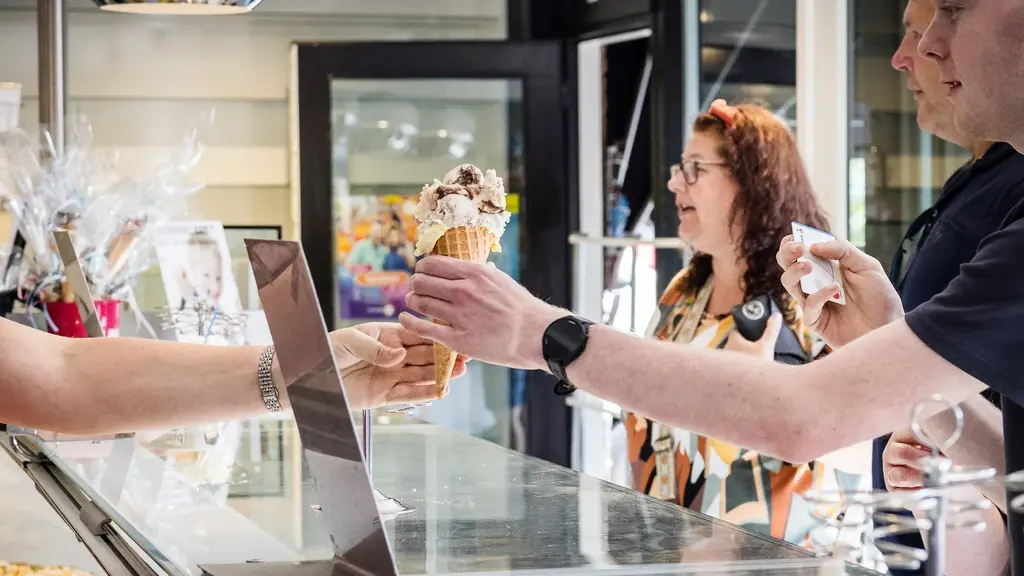
5, 10 or 15 percent? Card terminals are increasingly asking for tips.
You may have had to do this lately too: choosing what percentage tip you want to give on the card terminal when paying in a restaurant or bar. Or clicking ‘no tip’ after all.
The number of hospitality businesses doing this is growing, and we are also tipping more often when we have to choose. This is evident from figures shared by payment companies with the NOS. When giving such a tip, we most often choose 5 percent from the options of 5, 10, 15 percent, or a self-chosen amount.
Hospitality businesses using payment and software company Tebi can decide for themselves whether to display the menu. It turns out that at coffee shops where you order at a counter, the percentage of tippers skyrockets when they ask for a tip. Almost no one adds a tip by card if no request is displayed, but with a request, that figure is over 20 percent.
In upscale restaurants, customers often leave a tip by card anyway, even if not asked. With a tipping menu, even more people do so, according to the figures. Percentage of transactions with a tip
At surf school and beach bar The Shore in Scheveningen, they have been working with percentage tips for quite some time. During the pandemic, the business switched to card payments only. “Tips dropped drastically then,” says co-owner Thomas Franse.
In 2021, The Shore got a POS system that had that tipping option, and it was enabled. “That was definitely the moment the tips went up again.”
Franse has mixed feelings about asking for tips. “It is not the best customer experience. In the beginning, we received quite a lot of negative reactions alongside the positive ones. However, it is an important source of income for the staff.” He also notices customers getting used to it now, because more and more hospitality businesses are doing it. A tip menu on a card reader
Payment company Adyen compiled data on the proportion of hospitality business owners who are customers of their establishments who use a custom tipping menu. For restaurants, this rose from 19 percent in the first half of 2025 to 22 percent in the first half of 2026. For bars and cafes, it rose from 46 to 53 percent.
“This indicates that this is increasingly becoming a standard part of modern payment processes in the hospitality industry,” says Julien Marlier, Benelux Manager. On card terminals where the tipping function is active, 61 percent choose ‘no tip’. Consequently, 39 percent do leave a tip, averaging 4.31 euros.
Tebi also has figures on the percentage we select when giving a tip. Most often, people choose 5 percent. “About a quarter enter their own, usually small, amount,” says general manager Florian Brunsting. “High ‘American’ tip amounts are hardly ever seen.” In the US, a tip of at least 20 percent is expected in restaurants. How much tip should we give?
The Irish pub Mick O’Connells in Utrecht also has card readers with tip requests. “It is sometimes quite surprising who does and doesn’t give a tip,” says manager James O’Halloran. “Young students, from whom you wouldn’t expect a tip, might give 5 or 10 percent. Wealthier bank employees sometimes give nothing at all.”
The tip is usually 5 percent, he notes as well. “On average, we receive about 3,500 to 4,000 euros in tips monthly. That is distributed entirely among employees, based on the number of working hours.” On average, it amounts to about 2 euros per hour. Less personal
Restaurant and bar patrons react differently to tip requests. “I didn’t give a tip,” says Sophie, who ordered at the counter at a salad bar in Utrecht and had to choose. “I find it less personal. It’s just: here, do you want to give a tip or not?”
“I like it because then I can choose for myself what, if anything, to give,” says a visitor to The Shore in Scheveningen. He gave a 5 percent tip. “People work hard for it. So it’s nice to give a little something extra.” More often in Amsterdam
Whether entrepreneurs opt for a tip menu varies by region. For instance, in Amsterdam, over 30 percent of Tebi customers have enabled the feature, whereas in Nijmegen, for example, it is only 10 percent.
During a survey in Den Bosch, several hospitality businesses said they did not want to get involved. “I’m not really a fan of it,” says Marc Bouman of Brasserij Breton. “I’m not going to push tips unnecessarily; people give it if they want to.”
“If you show that choice, people might feel forced,” says Angie Joosten of Café CinQ. “For us, it works just fine to leave it entirely up to each individual.”
Canadian here.
Stop it. Stop it stop it STOP IT!
Refuse tips everywhere. If a business gives you the ‘option,’ refuse. Refuse, explain, and stop going there.
PENALIZE any place that sets up tip options. Hurt them. Drive them out of business.
Break the spine of tipping now. Before it’s too late.
Tipping is a thing in the NL. But this 15% nonesense by default can go fuck itself.
Tipping is gratuity, to be awarded for excelent service. If they dare ask me for a tip, I’d consider that rude and they’ll get nothing from me.
In practice “excellent service” too often means being a white girl with no ring.
Raise your prices and pay servers fairly and equally.
The whole concept of tipping is really just institutionalized bribery. It associates the idea of paying more with getting treated better. Like the man who slips the maitre d’ money in order to get a table without having reserved one, it punishes poor people by un-leveling the playing field. If I’m paying the amount that has been agreed upon, I shouldn’t have to worry that a server might neglect me to lavish more attention on someone who’s bribing them. If I’ve reserved a table according to the correct procedure, I shouldn’t have to worry that my reservation will be “accidentally double-booked” as a result of somebody else being willing to bribe the maitre d’. Rich people should not have an easy means to steal what they want from poor people.
just institutionalized bribery.
It’s even worse than that, it was a way to not pay free black people an actual wage and force them to be servile so wealthy white Americans could continue to feel superior.
Goddammit is there anything in this country that didn’t start for explicitly racist reasons?
The National Park system, if you ignore that taking that land in the first place was a genocidal conquest…
Does it happen often to you that you reserve a table and someone pays more to get it?
Never happened to me.
Fully agree. Always this “excellent service” argument. Reminds me of the scene in Reservoir Dogs (which was actually pro-tipping…).
Do I get a discount for being an excellent customer?
I mean, truthfully, white men have always been treated the best at tipping jobs and made the most money. Like that was very clear over ten years working restaurants. Women get judged by looks, and you can be the hottest babe in the city and still have women and dudes hate on you for the dumbest shit. White men can charm women, they are one of the dudes, they don’t have to be attractive. The sweating heroin addict even cleaned up.
What’s a fair wage? Servers can make $$$ from tips. $20/table with turnover every 60-90 minutes.
I don’t know about living costs in the US but sounds like you’re answering your own question?
I think $100/hr seems kinda high.
Well sorry to be rude but fuck their tip. If they don’t want fair wages then they’ll get unfair customers, like me.
This is how I tip. If I get asked to pay before being served food or beverage, no tip. Coffee shops, fast-food places, bust your table places. No tip. Ever. Sorry.
All the other places, 15%max. The restaurant’s junk fee gets deducted. Sorry. I’ll fight for your living wage. I won’t fight for your tip.
I mostly eat at home anyways so it doesn’t matter.
If i order standing up, I’ll tip the change.
Judging servers feels gross. Awarding and punishing for a meal? We have tens of thousands of meals. A few bad ones isn’t the end of the world. Let’s keep it simple and skip the judging.
Seriously, I live in Japan and I often want to tip because the workers provide—what is to me—excellent service. Even if were to try to tip, they would refuse. Whereas in Canada, I’m expected to tip for workers doing exactly what they’re supposed to do.
Tip is for exceptional service, not expected service.
I like the Japanese take on tipping. It’s actually rude to offer a tip because that puts the customer above the server. The server basically has to concede to my whims if they want the extra pay.
From the business’s point of view, the customer is already above the server. So, from what I understand as a Japanese dude (grew up in Canada though), I don’t think it’s rude to offer, but I think servers refuse it because it’s rude to accept. As in, that puts a burden on the customer. I think. I dunno, it seems complicated. All I know that it’s just not a thing here unless you go to a bar that’s obviously catered toward thirsty foreign guys.
The UK has a tipping culture but in pubs it’s considered insulting. “You wouldnt tip your psychiatrist, would you?”
In general we tip however the fuck we want, and a lot of people round to some number.
USA guy here: pls listen.
As an American, please don’t let this spread, our system is stupid and annoying
I personally love doing math before leaving any establishment. I have a sheet of math equations taped up to my door that I complete before I leave home.
/s tipping blows
To be fair, the system in question does the math for you. It is still contra to European tipping culture though.
As a Dutch person. Fuck that shit
As an American, fuck that shit.
As a Dutch-American, fuckfuck thatthat shitshit.
Another one here. Double fuck this shit. I’m not tipping. Full stop.
American here.
DON’T
Yeah just tip 0.
As an American living in the Netherlands for 4 years now:
NO, YOU MOTHERFUCKERS. NO.
welkom
(zonder tip)
Natuurlijk niet.
Waarom zou ik, of wie dan ook, meer nodig hebben dan een standaard “welkom”?
spoiler
Ik zal het je vertellen. De arrogantie van Amerikaanse ondernemers die de verantwoordelijkheid voor het betalen van een leefbaar loon rechtstreeks op hun klanten afschuiven. Daarom laten Amerikaanse obers je nooit met rust terwijl je eet. Ze zijn verplicht om uitzonderlijke service te verlenen, zodat de restauranteigenaar het loon van $2,85 per uur kan rechtvaardigen. Voor die fucking “tips”. Ik heb een grenzeloze minachting voor de zakelijke praktijken van mijn landgenoten.
De arrogantie van Amerikaanse ondernemers die de verantwoordelijkheid voor het betalen van een leefbaar loon rechtstreeks op hun klanten afschuiven.
Yeah, that’s exactly it. And it has been enshrined in US law.
(Sorry to reply in English, I can read Dutch but can’t write it and my pronunciation’s horrible.)
You’re contagious.
Like hell it is.
Card terminals may be asking for tips, but if they do that they’re getting 0% from me. Asking for a tip is rude and a guaranteed way not to get one.
I experienced it once at a place where I had to prepay for the drinks, so they dared to ask me for a tip before I even received service. The absolute guts of asking for a tip before even offering service…
Tips are gratuity awarded for excelent or exceptional service. Unlike America waiting staff actually earns a proper wage, so it’s not like they need tips to get by.
“… it is an important source of income for the staff.”
Source of income is their employment.
I don’t mind leaving a tip for great service, but it’s a few coins to round up and cash only. I never did and never will tip by card.
We pay very good living wages in the Netherlands so there is absolutely no need to this American bullshit.
I used to be a good tipper. I still am for genuine service, but the default “tip every transaction” has pissed me off enough that unless you personally handled my food, or performed a service for me, I instantly stab 0.
I was a a baseball game the other weekend, they had a self service kiosk for bottles of soda, a glorified vending machine. It had a default 18% tip added to the transaction that I had to drill into a menu to zero out. Fucking bonkers, not a human in sight, just a couple of sensors and a credit card terminal.
Tip culture has gotten way out of control since Covid, I’m refusing to participate anymore.
Just another category of junk fees. Those are creeping in everywhere.
Don‘t do this. Actively asking for a tip foils the very idea of tipping. It‘s basically soliciting.
In Germany the card terminals at restaurants started this too, but usually the servers are so embarrassed about showing it that they hit the 0% option themselves before they hand it to the customer or they type in the tip you said manually by hand in the “Custom amount” option.
Fascinating that software products are shifting culture. Product managers out here invisible-handing society.
The sales pitch is pretty attractive for those POS systems. They can prove with internal data that the tip button increases tips. If it costs the same as any other POS, merchants will always choose that system.
I’m interested in the perspective of the staff on this. I used to work as a barista and we had a tip jar that was shared at the end of the week. None of staff behaved any differently because of it. So, do the tips go to the owner? Are they allocated to who took the order? The chef?
Tips have their roots in the post-civil war reconstruction era where southern whites didn’t want to pay former slaves wages and instead cooked up this idea that you can work harder for more potential tips.
It’s a stupid outdated system. Pay people what they are worth. Give them healthcare and a living wage. And fix the broken tax system that favors wealthy business owners.
American here: Fuck off, “American style” tipping needs to die.
That would require service workers to earn a living wage, which is impossible. Simply can’t be done. Would be too hard for any business to bare. Sorry.
Simply can’t be done.
There are countries (Iceland for one) where restaurant workers are paid a living wage and tipping is barely a thing. So yes, it can be done. Whether you’d regard it as simple or not, I couldn’t say. And, because there are more people paid a living wage, there’s more demand for restaurants and cafes. It’s a virtuous cycle.
Dog-eat-dog economies are not the only possible kind, despite all the claims by neocons that it’s some kind of immutable law of nature.
No no no. I was told that this would set off an economy-killing inflationary spiral.
You can’t honestly tell me that more working-class residents with a higher income might become the foundation for domestic economic growth. Why, that’s downright Fordist! And we disproved Fordism under Reagan, when we decoupled wages from growth and the economy was 100% perfect for all eight years with no exceptions.
hell no this needs to go away
Honestly, even if we got rid of tipping all together, I’d probably still tip when I can. Even jobs like McDonald’s, I’ll slip a 2 or more if I can to person. Like the person taking out the trash or the cook. If I get a chance, without risking their job
Cause at the end of the day, I know that even sometimes, those $2 or $5 end up saving the day. Plenty of times, a tip has saved me from going hungry or missing rent.
I guess saying this, I’ve come to feel that tipping isn’t a bad thing. It’s a way to tell a worker that you appreciate them. What is a bad thing is when the government takes advantage of the kind nature of our fellow humans to hold down the workers.
Pay people livable wages, and allow folks to tip no matter the job if they want.
The staff suffers the most from the default tip. It puts them permanently on edge, and makes their job needlessly stressful. It is much better for the staff not to have to think about money at all while trying to do their job. In countries without the default tip, staff salaries are commensurately higher.
I agree. I’m saying we should still tip even when folks have livable wages. To show appreciation for the fellow worker. Totally, no one should worry about money they make at work. I just like to show folks in jobs that can be tasking on a person that someone out there see em.
As a fucking European, I tip when I want to tip. The employer should pay it’s employees!