We all talk about the big bang as this moment the Universe begins by popping into existence with simple hydrogen and some helium. Hydrogen and Helium are gases that are able to carry sound. Today, space has expanded so much that there is vacume beyond where matter clumps together to form stars/planets, which means the sound couldn’t propagate, but the early early Universe wouldn’t have clumped like today; there would have been hydrogen everywhere. This means it would have been loud everywhere.
*Edit: I know we call it the Big Bang because of the rapid expansion of spacetime, but I always just pictured the general motion of expansion as the “bang”. Never thought of how loud it would have been.
You must log in or # to comment.
the Universe begins by popping into existence with simple hydrogen and some helium
Not quite. The universe begins with a (mostly) homogeneous soup of sub-atomic particles that are far too hot and have far too much energy to be able to form stable atoms, not even simple ones like hydrogen – they’d get blasted apart again just as fast as they formed. It takes some expanding and cooling until heat/energy levels drop low enough for electrons to start orbiting protons and form atoms. (Not even protons could exist in the extremely early universe – fundamental quantum particles coming together to form protons, neutrons, and others would have been quite the development just a bit earlier in expansion.)
Hydrogen and Helium are gases that are able to carry sound.
And they did. This isn’t just speculation, we can actually see it!
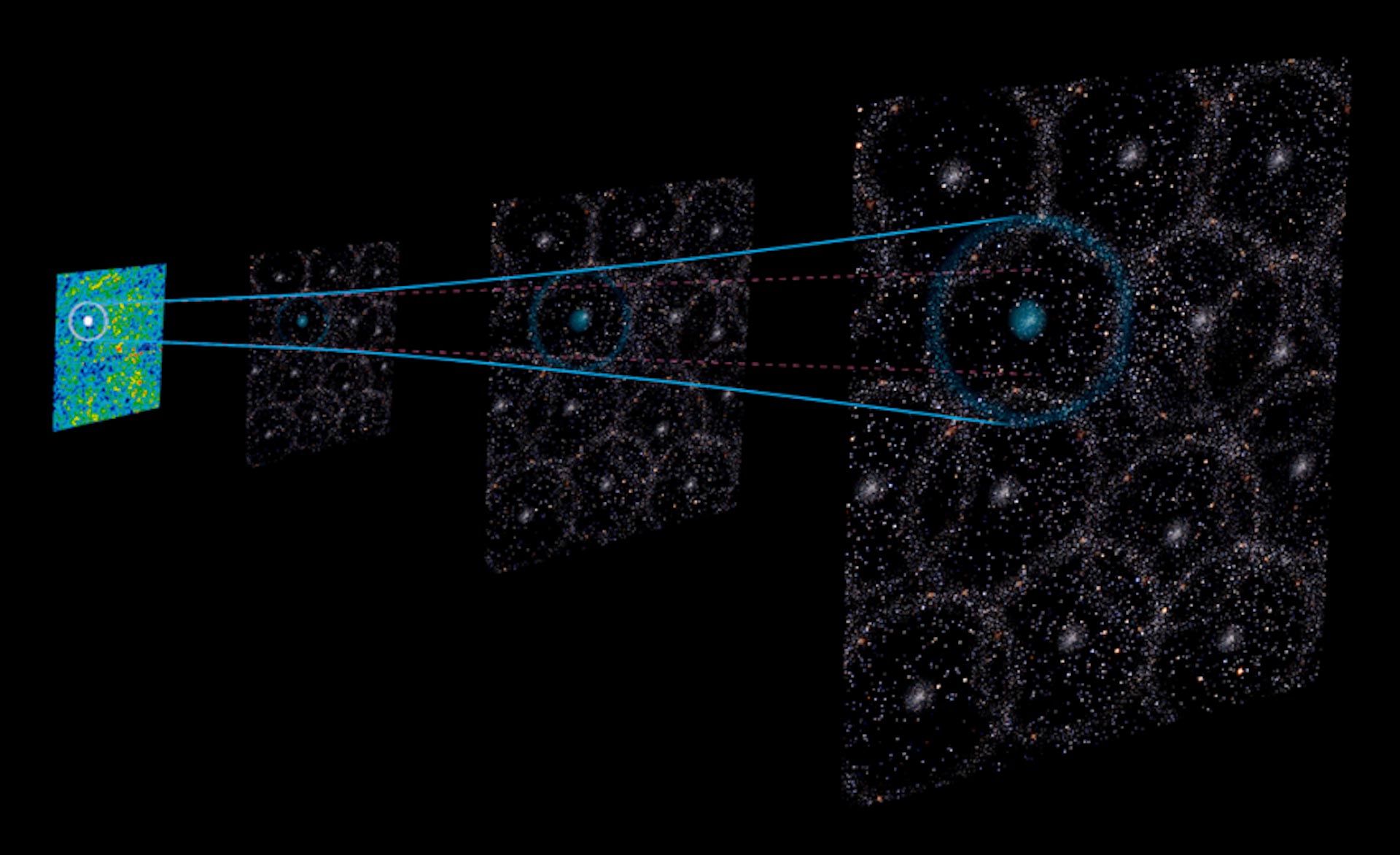
The sound waves in this very early universe (called baryon acoustic oscillations) went on to develop into the high and low density parts of the universe. They effectively ‘froze’ in place once the gas became too sparse to carry sound waves, and the pressure waves that were left at that moment formed regions of high and low pressure, high and low density. High density areas formed more stars and more galaxies (and attracted more dark matter) than low density areas. The sound waves in the early universe are actually what created the large-scale structure of the universe as we know it today.
And that’s not just hypothetical speculation. These wave patterns have been detected and have been known for decades. Yes, the early gas-filled universe was very loud – and we can still see that today!
Epic
 ___
___Well that’s pretty amazing
I would’ve thought it would be pretty silent as there were no atoms and no medium for sound to travel at the initial moment.
there were no atoms and no medium for sound to travel
Are we sure sound specifically needs atoms to propagate? Maybe its just matter (meaning the subatomic soup from before atoms formed) that propagated the waves? Or, maybe when the atoms coalesced such that the violence of things would have finally been able to ring? Wonder what note it would have been?
Loud? Maybe. But at what frequency? Would it have been a super loud C sharp? These are fun questions to think on. Wish I knew how to ask Dr. Tyson on Star Talk.
You throw money at him on patreon nowadays and ask on there. Then they might put it on an episode.
All matter was packed in so tight it was an unending singularity. Sounds pretty loud to me.
“And on the first day the flying spaghetti monster ripped the most epic fart ever and reality was born”
It was so epic that some day that the FSM is still getting reactions from those who know him to day.
Think about how high pitched our voices would be at that event, assuming we survive the heat.
assuming we survive the heat
You absolutely, definitely would not.
Well you’re no fun…
Superman could.
Could he?
He gets his power from our ‘yellow sun’ and is powerless without it. No stars of any kind existed at that time, so he wouldn’t have the source of his power.
Yes, he mutates to absorb the heat and becomes double golden superman 9000 whenever he goes that far back. Pretty well-known DC lore.
Yeah … I’m just going to take your word on that.
Here’s one for you. “The edge of the known universe” is that where there are no more star or galaxy formations? Or could some objects be so far away, there aren’t enough light particles left traveling those vast distances to be seen?
I wonder if: our solar system resides in a galaxy of other solar systems, then our galaxy resides with others in the universe, are there other universe clusters in another unnamed grouping we haven’t thought of yet?
I feel like we’ve often just thought of the edge of the universe as, “that’s it, that’s the end” but… is it???
The edge of the observable universe is not because of that.
It is because space expands. Therefore everything goes away from everything else. Therefore, everything goes away from us. And the more space there is between us and that other thing, the more space expands, since there is more space. Therefore, things that are farther away from us, get away from us faster than everything else. Only if it is close enough to us that gravity is strong enough would that something not move away from us.
This creates a peculiar situation. Things that are far enough away from us, actually move away from us faster than the speed of light. This means that no photon ever emitted from this far away will ever reach us.
That is the edge of the observable universe. The distance at which a photon emitted in our direction will never reach us, since for every meter the photon travels, there is at least a meter of space “created” between us. Therefore it never progresses in moving towards us, in fact, it moves away from us even though it is traveling in our direction.
It takes light a fixed amount of time to cross a fixed distance. The farther something is away the older the image you will see. In effect looking farther out is like time travel.
The edge is simply the line where not enough time has occurred for the light to reach us.
I get that, and I get there’s stuff that we haven’t yet, “seen” that could exist that we don’t know about yet… But I’m saying could there have been “big bangs” from other large masses we also don’t know about (because we can’t see it) and therefore a ‘multiverse’ in the sense that there are even larger distances between universe clusters.
Let’s think about time for a second (well, more than a second):
- Second = house
- Minute = city
- Hour = state/territory
- Day = country
- Week = continent
- Month = planet
- Year = solar system
- Decade = galaxy
- Century = supercluster
- Millennium = universe
OK so with that comparison, we see scale. But what’s beyond a millennium or universe? I’ve found 1m years is called a megannum or aeon. So what’s the equivalent in space? Beyond the megannum (million) I’ve found gigannum (billion years) and terannum (trillion)…
My point is we often refer to the known universe as whatever we know or have seen to exist, but that’s a sort of dynamic or organic designation vs a unit of measurement. We should have units beyond the universe for all the hypothetical existence beyond what we know. To continue the scale:
- Megannum = (Name for cluster of universes)
- Gigannum = ? 13 . Ternnum = ?? (Even necessary?)
Edit: I know I’m going down a rabbit hole, but should universe refer to 1 (being uni) and then megaverse match megannum? Then gigaverse refer to a cluster of megaverses? Just… Time consuming to think about how big those could actually be.
Should we also call a new measurement of light travel time to extend light years to light decade or light century to get a gist of even greater distances? I know. To fathom is mind boggling. I’ve wasted so much time at work today already on this comment 😅😅
The edge of the known universe" is that where there are no more star or galaxy formations?
I believe that would be an area where time has some weird effects, because time is a function of space (as I understand it). There would be no space, there.
But it’s also hard to say whether such an edge even needs to exist. The universe expands everywhere all at once, not from an “edge.” It’s making more space everywhere. Like bread expanding in the oven.
Or could some objects be so far away, there aren’t enough light particles left traveling those vast distances to be seen?
That’s the “observable universe” and totally exists.
Obligatory Karl Pilkington:
was it a big bang or did it just seem big because there wasn’t anything else to drown it out at the time?
If a bang happens in the universe and no-one is there to hear it, does it really make a sound?
No. Because sound is the brain’s perception of vibrating air pressure.
No brains = no sound.
If a tree falls in the forest and there’s nobody around to hear it, does it make a sound?
Some argue it does not, since sound is. An interpretation of pressure waves in a particular frequency range.
I personally believe it’s still sound. Even if it’s not heard, it can be recorded and replayed, therefore any time there are pressure waves within specific range they should be considered sound. If you play music on the radio and nobody is listening, it makes a sound, but if you transmit it only using AM/FM it does not make a sound.
Having this definition down, yes, it must have been one Hell of a bang, but so what?
but so what?
Maybe how sound waves collided influenced how matter clumped?
Maybe the soundwaves colliding is one of the many reasons for these:

I think you have to differentiate between simple pressure waves or even shockwaves and soundwaves.
Like Michal said, usually something is only defined as sound if there is something to hear/interpret that sound. Otherwise it’s just waves in a medium, like any other kind of wave. What we humans consider sound and what a whale or a dog considers sound is not the same.
For the most part the beginning of the universe was very hot. Sure there was fluid dynamics going on, but would we consider that loud? Or just very hot?
As for the reason something essentially random had structure is very interesting, but I don’t think fluid dynamics or soundwaves had anything to do with it.
but if you transmit it only using AM/FM it does not make a sound.
That you can perceive, if something else can … is it then sound?
Depends how you define sound, i just wouldn’t count electromagnetic waves as sound, only pressure waves.
Big bang if true
The entire universe was opaque to light for a while
Where did the hydrogen and helium come from?
Well, from what I understand, the protons clumped from the subattomic particles, but the electrons all just swarmed around unbound until the Universe cooled and the electrons bound to the protons. But, maybe PBS Spacetime or StarTalk can explain it better.
Thanks for that however, it leaves us with the same question as before;
where did the protons and electrons come from?
From the subatomic soup of particles.
Where did that come from? If you can answer that, I think there’d be a prize in it.
(It was not from a man in a bedshirt and sandals)
Where did that come from? Is the question indeed
However labeling or criticizing just how anybody is looking for the answer, is just wrong and usually insulting, even to scientists.
Science is about answering the unknown and making it known. We know it wasn’t a guy in sandals so far and have yet to see evidence of a god in space so far, at least the one that puts cancer in children to teach them a lesson on life and demands you to read a book made by King James.
Yeah but nothing was there to hear it
How do you know? You weren’t there. Well… Not in your current form anyway.