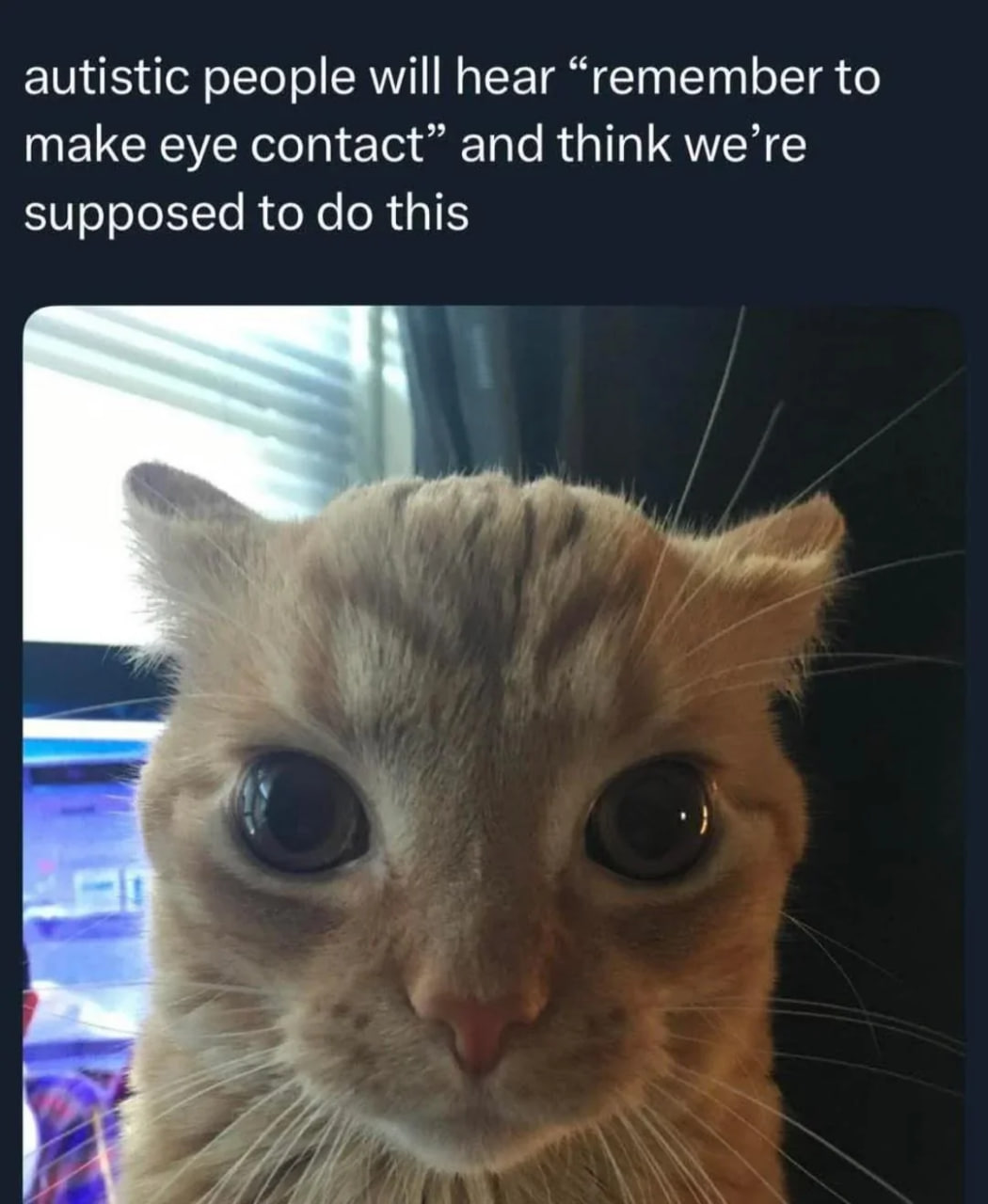
I think I just realized why people think I’m weird
I read a hack about looking at their lips instead and it’ll work. Nope. More awkward.
ADHDers: Blinking and sweating profusely as they try to maintain eye contact and focus on the conversation
One of my first hints I was on the spectrum was realizing that after my dad told me to make eye contact, I switched to “scarily intense conversation partner” for this very reason.
Wait, so what is eye contact?

I hate it.
Thanks I hate this! 🫠
It’s a little hard to explain, especially without resorting to stereotypes (please forgive me if I do so; I’m trying), but NT people shift their gaze as part of active listening. We’ll fix our gaze more firmly if we’re saying something controversial, or draw it in if we’re saying something conspiratorial, or use it to gather our interlocutor’s attention before doing a facial expression. A lot of the “eye contact” that I make is actually with the bridge of someone’s nose, or their cheek, so it feels less intense while still showing interest. Some autistic people can become almost transfixed in their gaze, like they’re so focused on looking right into your pupils, that it seems to me they forget that the eye contact is in service of other conversation cues to help your interlocutors understand where your attention is.
Sometimes I have doubts if I’m autistic or not. Then I read shit like this and yeah I’m autistic. Did someone tell you to look at their nose or cheeks? That counts? How did you know not to death gaze into directly into their pupils when you make the effort to make eye contact? Eye contact helps with conversational cues?! Wild it make senses, but I’ve never put two and two together
I always look at people’s right eye, and though I see their eye contact shifting back and forth between both of my eyes, I can never bring myself to do the same. Looking at the left eye just feels weird. Like, I already chose the eye to look at, stop making me devote brain power to thinking of when I’m supposed to look at the other eye.
Not always making direct eye contact is something I was told once as a strategy for seeming confident when you’re nervous; other than that they all come to me naturally via mirroring. It’s actually pretty hard for me to think and talk about this kinda stuff because I do it all intuitively, and it’s hard for me to divert enough attention to notice precisely what I’m doing during conversations because I’m too busy focusing on the other person and our conversation to think about how I’m emoting.
Feels like you’re getting at the crux of why this is difficult. It’s something NTs “just do” without thinking anything of it - like breathing. It’s not like they can explain the “rules of eye contact” but, also, they certainly will notice you not doing it and they might not be able to put their finger on why that interaction feels off to them.
It’s when your eyeballs are physically touching their eyeballs.
wait, you guys do it unconsciously?
yeah it came by default with my os idk
is it TempleOS or something? 😭
nah he was schizophrenic
So many arbitrary rules, ffs.
It swings around 180 in other other odd ways. About 100 years ago, when I went through my dating period, I kept finding myself across tables from men who thought if I didn’t do this while they were talking, then I wasn’t attending to them or their words.
Ditto, on eyes turning inward to focus on and visualize what they were talking about, an aspect of full attention. Apparently, doing that meant I was tuning them out and letting my mind wander to other things. They “could tell”.
Needless to say, I encountered many a one date wonder who never moved past that initial interview.
Blinking, internal imagery, and not staring are pieces of standard, WNL attentive conversation.
My boss only makes eye contact when he’s picking his nose
Asserting dominance. You must make eye contact and pick deeper if you want his job.
I don’t want his job it sucks
Also: Many people make the mistake and pick their own nose. You need to copy your boss. If he’s picking his nose, pick his nose as well.
Pick me a winner. 😳