

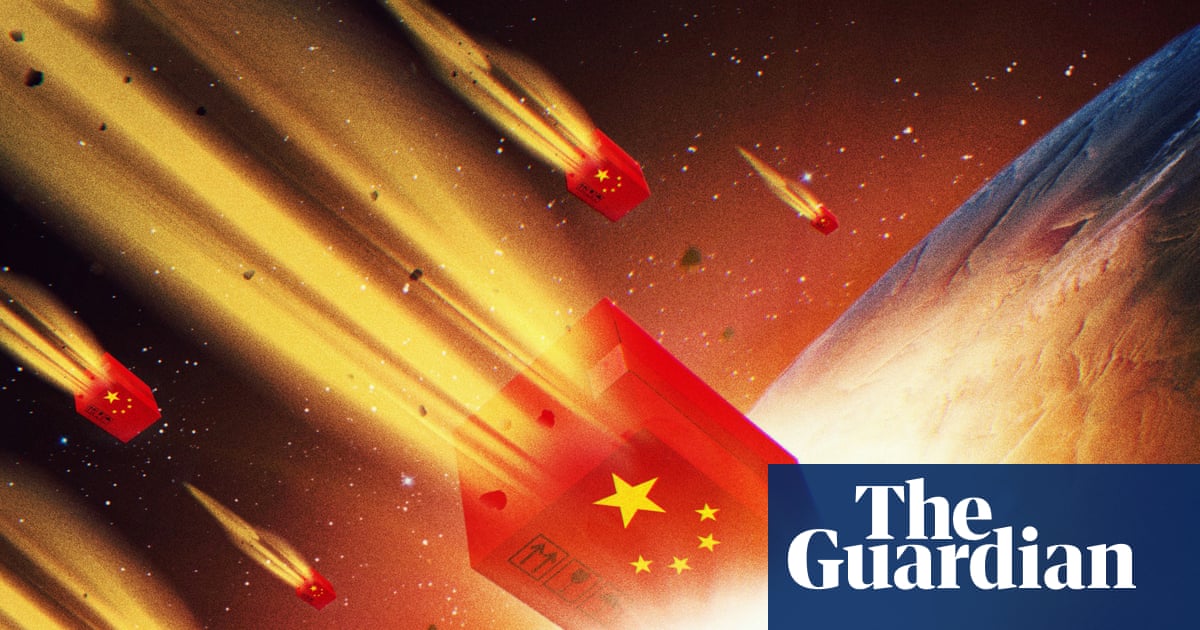
When the Canadian prime minister, Mark Carney, took to the podium at the World Economic Forum in Davos last week to lament how “great economic powers” were dismantling the international order, it seemed clear that he was talking about the United States. He might have been talking about China as well.
Not a week earlier, Beijing had revealed that China’s trade surplus ballooned by 20% in 2025, to $1.2tn. Despite Donald Trump’s wall of tariffs that crashed Chinese sales to the US, its overall exports expanded more than 5%. Sales to the 11 countries in Asia’s Asean bloc increased more than 13%. Exports to the European Union rose over 8%. Chinese imports, by contrast, were flat.
This gargantuan imbalance is strangling manufacturers from rich countries in Europe to poorer nations in Asia and Latin America. As Eswar Prassad, a former head of the China division at the International Monetary Fund, now at Cornell University, pointed out: “Forget Trump’s Tariffs. The Real Danger Lies in China’s Trade Surplus.”
Many factors contributed to the implosion of American governance. But Trump’s rise was largely propelled by a sense of grievance against a world order that, Americans believed, had taken the US for a ride.
America’s pain was largely self-inflicted. Manufacturing’s footprint shrunk in Germany over the last quarter century, like it did in the US. It shrunk in the UK and France, Italy and Japan. While those shifts have caused domestic political disruptions, in none of these other countries did voters try to punish the rest of the world for the loss, as Trump has.
If China is so “overbearing,” don’t trade with them. Don’t buy their products. Follow the US’s lead and tariff the hell out of Chinese imports. You don’t have to import Chinese products. You can choose to not buy Chinese stuff. No one is forcing you to buy Chinese products.
Smear shit on my face, stab my friends, murder my own people, rape children then go bankrupt?
The comment is a response to the title - that China’s exports are “overbearing” as if China is inflicting trade on others unilaterally. The point is that whatever extent to which the US is a victim in this, it was a victim entirely by choice, and a great many people in the US for richer for it. They could have decided not to bypass the local labour market by using China for manufacturing, but there was profit to be made. China just got good at it and used it to their advantage.
Is the problem that China is too good at what they do, therefore we need to artificially redirect demand to less-competitive alternatives?
The capitalist mindset is a sight to behold. Hopefully future generations learn from our mistakes and laugh at us for the dipshits that we are.
While that is true in theory, it’s also true that it’s a little more complicated than that.
My understanding is that in the past, the US tried placing tariffs on steel originating from China — steel being a strategic good, something where there’s a positive externality to having a secure supply — and it wound up effectively being routed through other countries.
A second issue is that it’s not just a matter of the steel moving through countries directly, but the fact that products can be manufactured in other countries using steel from China, and there isn’t any system for tracking that. Like, say I buy a desktop computer case made of sheet metal from, oh, Taiwan. Where did the Taiwanese manufacturer get the steel from?
searches
Here’s something from Brookings (Brookings not being particularly enthusiastic about either Trump or protectionist trade policy):
https://www.brookings.edu/articles/is-china-circumventing-us-tariffs-via-mexico-and-canada/
By the time the US did any of this, they had already lost most of the manufacturing capacity and supply chains. I don’t think this can be brought back through small changes in the capitalist free market model that shipped it overseas. The US shipped manufacturing across border to other countries such as Taiwan and Mexico before China. Through a more holistic lens, I think what we’re observing is the Chinese mixed market model outcompeting the capitalist free market model. It’s able to spur competition where needed to develop new technology and manufacturing, as well as keep prices down to avoid rent-seeking in established, consolidated industries. We’re failing on both accounts and the result is consolidation and unmitigated rent-seeking in virtually every sector which makes competitive manufacturing impossible. This is why my bet is that countries with real independence ambitions that want to preserve democracy would begin adopting the Chinese mixed model to bring costs down and outputs up. We’d see more government-owned corporations that run as non-profits, providing cheap inputs for the rest of the economy, where competition would be created by policy-directed public capital along with ruthless anti-trust enforcement. Democracy would still control the government direction, with much stronger union power. In case this looks strange or unrealistic, this close to how the Canadian among other western economies worked prior to neoliberalisation. This is my positive, democracy-preserving scenario.
The other likely scenario I see for preserving independence is large private corporations taking over the government further, removing any remaining real democratic power of the citizenry, crushing labour rights and dispensing with any remaining competitive market forces acting on them, driving into some form of corporatocracy/authoritarian capitalism. This is what the US is driving towards.
There’s other scenarios for the non-independent states that depend on what China’s long-term strategy is.
Ok, well, if tariffs on Chinese imports won’t work because China will just find ways to circumvent them, then you just have to accept “artificially” cheap Chinese goods being imported into your country, unless you can convince consumers to stop buying them. That likely won’t work either, but I don’t see any other option. You can ask China to raise their prices but I imagine that’s already been tried and likely also failed.
China wasn’t circumventing them. Buyers circumvented them. Middle-men emerged in response to the tariffs because there was margin to be made. China just sold to whoever was buying
Then if the US is serious about preventing the supposedly “artificially cheap” Chinese imports from coming in they need to crack down on those importers circumventing the tariffs. If we can’t or won’t, I don’t see another option other than to just accept cheap Chinese imports. And that goes for any economy angry about China’s supposed unwillingness to “play fair.”
I assume that what articles like these are advocating for is that importing countries come together and somehow bully China into raising their prices. But whether it’s that or tariffs with better enforcement, the result is the same: no more cheap Chinese goods, meaning higher prices for customers who have gotten used to the lower priced imports from China.
Correct. The only solution is to invest in domestic production for decades and attempt to catch up to China while China is constantly advancing ahead of us. And to do that would require the government to spend the money because it wouldn’t be profitable for years and years and years. And even then it might only be profitable in combination with tariffs. And tariffs raise the price of inputs to the economy, which makes the economy unprofitable.
It’s almost like capitalism is failing.
Yeah, and it’s taking forever. It’s like watching an ultra show motion train wreck. It’s maddening.
If the decision was that simple, it would be obvious. But it’s not. Lots of countries don’t have the capability to manufacture those products they import.
Why do they not simply build it, you ask? Because that takes a lot of time, money, knowledge, coordination, and motivation. A developing nation with low capabilities and high corruption is never going to be able to compete with China. You can give them a bunch of money, but if it just goes into people’s pockets, it doesn’t build a factory. If you build a factory, you need people willing and able to operate it, not to mention you need stable utilities and raw material input.
Why would I invest in building a factory when I can just import the same thing from China right now for mere dollars?
The Chinese government owns about 50% of the manufacturing industry in china. It’s difficult but entirely possible if the governing power truly wants to. Need only look over at Africa.