

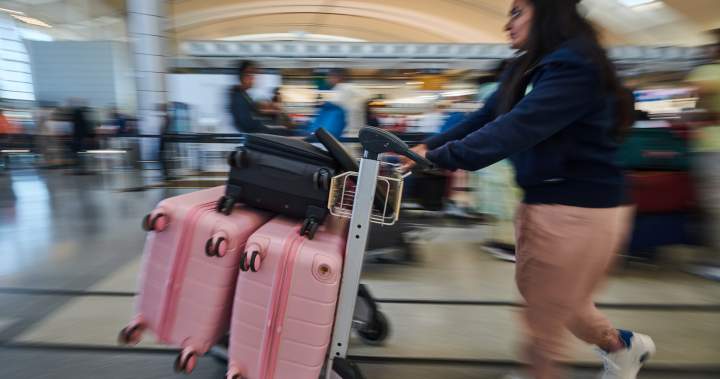
For the ninth consecutive month, fewer passengers at Canadian airports are heading to the United States amid the trade war.
New data from Statistics Canada shows total Canadian air passenger traffic in October was up by 4.5 per cent to five million travellers from the same time last year, but the number of people on U.S.-bound trips is down 8.9 per cent to 1.2 million travellers.
Air traffic to USA down 8.9% is very significant, and way beyond any statistical variance or uncertainty. Numbers at that scale tend to change slowly, so by that perspective 8.9% is a lot.
And ironically the Canadian economy is up 2.6% in Q3, and industrial production is up 3.3%. And inflation is down to 2.2%!!
So Canada is doing very well on major economic markers despite the sanctions from USA.
USA on the other hand is not, and Trump is so embarrassed he won’t even allow his fudged numbers to be released.
I call them fudged because he fires people who release “bad” numbers, because Trump claims bad numbers are fake.
Careful with looking good or tey’ll invade you.
What’s really insane is that we can’t rule it out completely. USA is being run by a bunch of sociopaths, and Trump has dementia which undermines the little self control he used to have.
Thats nice and all, but none of this apparent success is helping cost of living in Canada. According to my Canadian family, grocery bills just keep on rising.
Except lower inflation is doing exactly that.
Most of the world has been through a period of increased inflation, but Europe is getting it under control now, and apparently so is Canada. So yes this should definitely be helping.
Having just double checked with my Canadian family, and then checking their sources, nope, inflation directly affecting cost of living is not getting under control there. Food price inflation is up 4.7% for 2025, which is more than double the rate of inflation for the last year.
Meat, Coffee, Fresh Fruit, and Fresh Vegetables are apparently the worst hit categories. Also, I got to listen to a mini-rant about Shrinkflation.
Food is not the whole picture:
https://www150.statcan.gc.ca/n1/daily-quotidien/251215/dq251215a-eng.htm
https://www.cbc.ca/news/business/canada-inflation-rate-unchanged-november-2025-9.7015905
So Canada has their overall inflation under control, despite increasing food prices. Where I live food is only 10-12% of an average budget, and so similarly is only 1 part out of many when the CPI inflation number is calculated.
Transportation, heat, clothes, rent and other things are also included in the inflation number, to better reflect a normal budget. Rent is often a bigger expense than food.
Compared to Canada having 2.2% inflation YOY in November USA has 3%. In USA it may be even higher than 4.7% for food IDK.
Also in USA where many people live below the poverty level, increasing rent and food prices are more serious.