

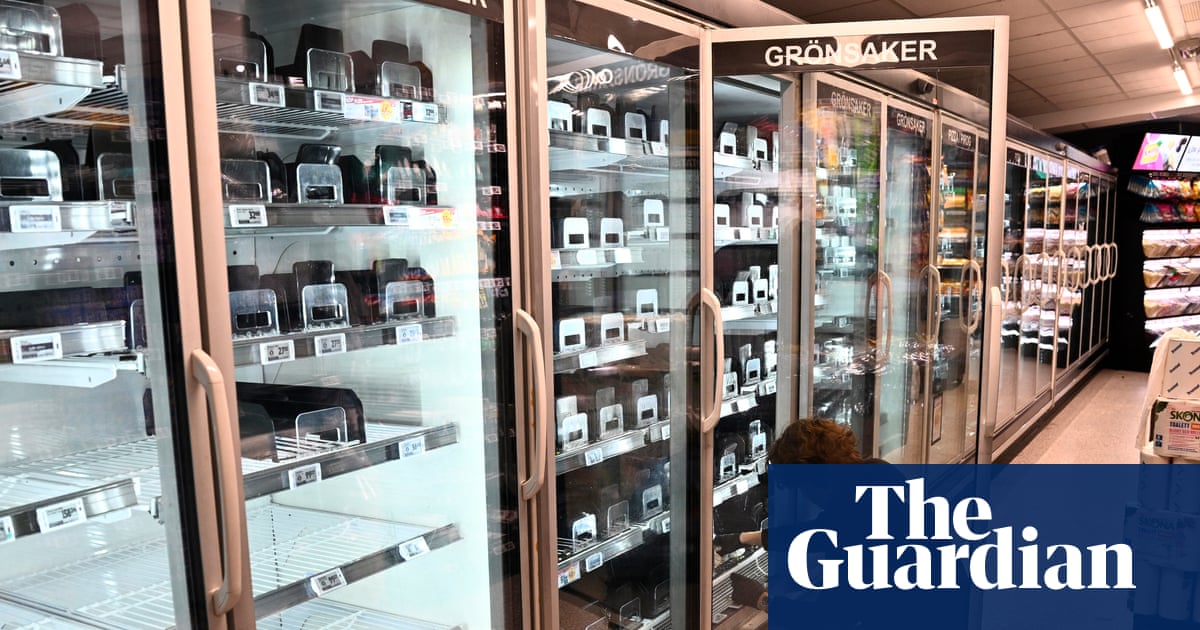
Chains in Sweden, Belgium and Luxembourg say fridge temperatures rose overnight, similar to hack of French stores
Supermarket chains in Sweden, Belgium and Luxembourg have said the temperatures of their refrigerators and freezers in dozens of stores rose overnight, prompting fears of a cyber-attack similar to one that caused millions of euros of food losses in France.
Sweden’s Coop chain told the daily Aftonbladet on Monday that six of its stores had been affected, while ICA said it was “aware that a limited number of stores were affected by an incident overnight which impacted their refrigeration and freezer systems”.
Maybe not everything needs to be on the internet.
The question isn’t so much, “Why were these on the internet?”, so much as, “Why were these not securely connected?”
At my last job, our AWS resources were firewalled off, only accepting connections from our internal VPN. To get on that, you had to be coming from the IP of an office or a DevOps team member’s home IP.
The local firewalls could have only allowed traffic to the freezer VLAN from the remote monitoring IP.
And that’s just two ideas off the top of my head. If my dumbass can do it, you don’t need a high level networking expert to fix this.
YTF does a refrigerator need to be on net control??? Isn’t it a set once and forget it device? Maybe to monitor it to report a failure… but to CONTROL it???
it’s so they can sell subscriptions to the cloud bullshit.
It’s more convenient for the hackers this way, duh
Stop connecting shit to the internet, this is not a difficult problem to fix.
I was gonna argue that a local remote control alternative doesn’t exist, but I really don’t know why you’d need freezers to be remotely controlled. They’re more of a set and forget.
Walmart had that since the early 2000’s. Fucking bullshit then too. We once had a section go out and called corporate and they argued it was working because their computer said so. Fucking dumb asses we are looking at it and some asshat in Arkansas (we are in Texas) tells us we are wrong. They finally agreed to send a rep from headquarters to drive down and look for himself (who knows cost of that) just for that guy to go "yall right it broke. " Then.we got local guy come fix it.
I work for the food industry, in automation. Our whole factory is connected. To the point that from my office, I can control most of the factory machines. From my office, from my laptop that needs to be connected through an ethernet cable to one of the tech network of the factory.
If I want to connect from another device, I need to set up a vpn with credentials and an authorised IP.
The only way to access our tech network from the outside is stealing my credentials and then ask some of my colleagues to authorise a device and IP for my credentials, something highly suspicious that would raise a lot of alarms.
I’m not going to say that a system like this is infallible but turns an attack like this extremely unlikely. This is how you should have your systems “connected”. Not through a login portal exposed to the damn internet.
Thanks I’m now in your system
Oh shit! While you’re in, can you please check my email and maybe answer some so I don’t have to tomorrow?
Thanks in advance!
👏Stop 👏 making 👏 everything 👏 connect 👏 to 👏 the 👏 internet👏
You mean to tell me that none of these people thought to disconnect them the first time?
It was on the agenda for the next quarterly interdepartmental meeting, and after that needs a cost estimate and budget approval to actually start working on the issue.
Curious to hear from someone more knowledgeable about security if this seems like an economic attack by another country, or what? The only other motivation I can see here is to force supermarkets to be more secure without doing serious damage (serious like people starving).
It’s most likely some script kiddie taking advantage of hilariously bad security practices. The attack three weeks ago was because the freezers were directly connected to the internet, running old vulnerable firmware with the username “admin” and the password always being the current date. This is probably going to end up being a similar case - might even literally be the same case, three weeks (and IIRC there’s been an update fixing it for six months) is such a short time to unplug your vulnerable freezers from the internet, after well.
Idiots…
The first and foremost sign of intelligence is the ability to learn. Somehow, those supermarket owners seem to lack this important trait.
IT Security sits in cost center side of the business for these Legacy companies.
It’s very much a " everything is fine why do we pay you?" Or everything is broken why do we pay you?" Situation
Yeah, this is why I resist getting a job actually doing mainly IT security despite having been part of far too many incident response and recovery teams over the years. It seems like a no-win job at the moment because leaders rarely value it.
You’re asking capitalists to slightly not maximize short term profit… good luck.
Perhaps worse, you’re asking people who are full of themselves to question whether they might have been wrong/uniformed about something.
Again, good luck.
No they’re pointing out that supermarket owners are dumb as rocks.
Are supermarket owners in Europe typically… capitalist?
I am pointing out that the system that creates and maintains ‘supermarket owners’ does so in a way that also selects for and emphasizes certain traits in supermarket owners.
They’re sitting exposed to the public internet with a well known and super basic password. If your shit is on Shodan, you better know in detail the multiple layers of protection in use. Today’s date is not a password.
I think the takeaway here is how lucky these supermarkets have been. Any threat actor who’s organized would recognize the potential here and work to establish a proper foothold in the organization and try to pivot to corporate or payment networks. Instead they’re just turning off the refrigerators.
They are grocery stores, not some break room fridge. This attack is both economic (for the spoiled food that needs to be thrown out and the price increase that will come with that reduced supply) and on health (because not all spoiled food will necessarily be recognized as such in an effort to avoid the first consequence, plus if the fridges containing milk go warm for a few hours, they can test some milk and it’ll probably still be fine, but that best before date is now likely useless at best or misleading at worst). Also, even if most food is fine, if some food isn’t, it will mess with some people’s heads pretty badly.
If the intention behind the hack was disruption and damage, IMO this is one of the more effective angles they could attack.
Milk will not have any problems if it was not opened in the first place
Milk will have problems if it’s the 50c fast-defrost cycle that the fridges in the first attack reportedly hit.
Oh yeah i guess it might have problems then
If that was the case, why do they spend so much money on keeping it refrigerated before people buy it instead of being kept on normal shelves with all the other “refridgerate after opening” foods?
Depends on the kind of conservation method they applied to the milk. Milk that was sterilized at lower temps is considered “fresh” and has to be kept refrigerated. Milk that has been pasteurized at higher temps is sterile and won’t cause bacteria to grow even if it’s kept at room temp.
This however changes when you open the milk and it enters in contact with microorganisms that are naturally present in the atmosphere and that can proliferate in the milk; to avoid this, you need to keep milk at fridge temps so bacteria won’t grow too fast (if you keep it open in the fridge for too long, bacteria will grow anyway and the milk will go spoiled).
Idk in other places but here where i live, many supermarkets keep it outside the fridges ¯_(ツ)_/¯
Ah interesting. I know eggs can be (though the industrial washing they get changes that by removing an important protective layer), but figured the few times I got milk that went bad before the best before date it was because it wasn’t properly stored before I got it.
Might depend on the pasteurization method maybe? Like the “bring it close to boiling” doesn’t kill everything in it but the chemicals might? (Speculation)
Edit: apparently it has to do with the temperature it is pasteurized. There’s one version, most common in north America, that pasteurizes at slightly under a boil, which doesn’t kill everything in it and requires refrigeration before opening.
And then there’s UHT milk, which is pasteurized at 138°C, and this apparently kills everything such that the milk doesn’t need to be kept in the fridge until it is open, and is more common in Europe and parts of Asia.
If the fridges were just turned off sure, but they were actually heated up to 50 °C.
Yeah except people turning them off now doesn’t preclude the freezers from your other possibility. It’s entirely possible someone somewhere has been sitting on access to those things for a while and only recently did a Claude script kiddie get in and start messing around with things.
Why these on network with outside access?
Because stupid. There’s zero reason for them to be on the public internet beyond incompetent operational IT security.
Exactly ; the concept itself is the real flaw.
In theory they gather all sorts of data so they can see how efficiently they’re running, whether maintenance is needed. If something goes wrong with one of the units they can dispatch a repair guy immediately, or have the store shift the food before any spoilage. If they’re smart about it they can use the data to set up an efficient preventative maintenance schedule and really stay on top of things.
A chain that has 500 stores with 20 units a piece adds up fast. They probably have a person at headquarters whose only job it is to stay on top of these units.
You do that with your own internal network or, at max, with a vpn. You don’t need them to connect to the internet at all.
No reason not to connect to the internet. Put the units on their own VLAN and firewall that off from anything but the IP of the monitoring end. Plenty of other ways to make this secure, that one’s off the top of my head.
Exactly why do you need to do this instead of just keeping everything out of the internet and then connecting through a vpn tunnel?
If you need to monitor these 24/7 for some reason, pay a department that works 24/7 locally. Otherwise is just half-assing solution that will end like this sooner than later.
No reason at all to connect any kind of sensitive machinery to the internet, especially if remote operation of it can cause harm or damages.
That one’s not very secure.
Yup, absolutely correct.
Automation engineer here, this is 100% a problem with their network model
you would think people owning these stores might have prepared for this by not having those fridges online anymore…
on the other hand… why should they, as long as the insurance pays
Insurance is not free, they increase your premium when you make large claims
obvio, but that is a problem in their future, not in their present which these type mainly seem to spend on “how to make a load of cash quick?”
Why would insurance be eager to pay for something easily preventable? If it is the same known vulnerability then maybe they could deny?
as far as i know, as long as it is covered: it’s covered. and as long as the insurance didnt change the rules yet, why should anyone prevent anything?