

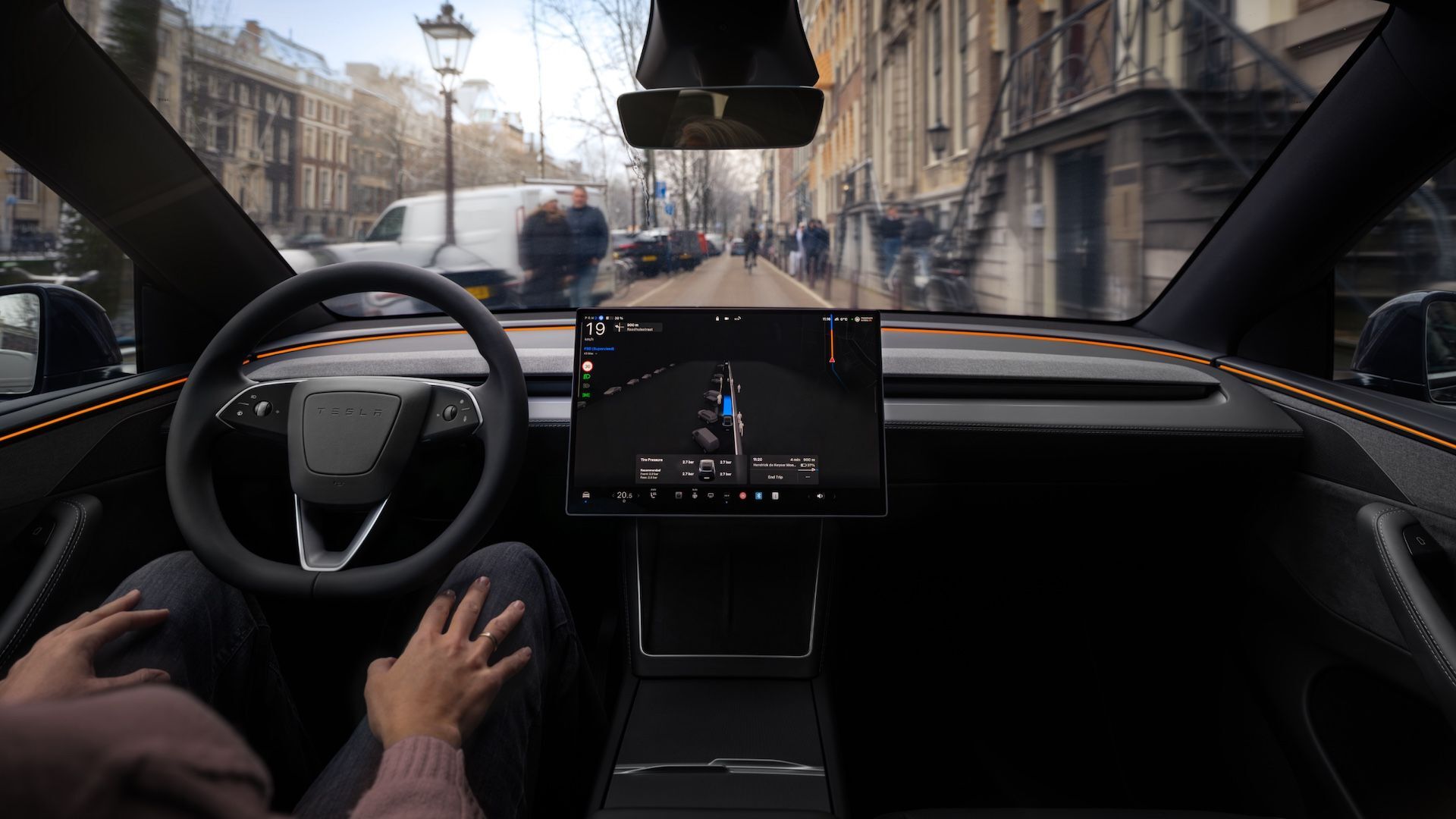
Over the past 18 months, Tesla has been working with the Dutch vehicle approval organization, RDW, to get approval for its Full Self-Driving (Supervised) semi-autonomous driving system.
After a long consultation period, which included covering almost one million miles with FSD (Supervised) active and offering ride-along trials with 13,000 people in numerous European countries, the RDW deemed the technology safe to be given the green light.
Tesla’s controversial CEO, Elon Musk, has long-promised to introduce the partially autonomous cruise control system to other markets outside of the US, where it has been on sale for years. But the company has regularly butted up against regulatory red tape.
According to a press statement put out by Tesla to promote its European debut, the company says that when FSD (Supervised) is engaged, collisions are up to “seven-times less likely per kilometer driven compared to manual driving alone”.
However, safety campaigners, such as Dan O’Dowd of The Dawn Project, reiterates that “59 people have been killed in over 3,000 crashes involving Tesla’s self-driving software in the U.S. since 2021 alone”.
“The RDW’s decision is deeply troubling given Tesla FSD’s myriad of well-documented safety defects,” O’Dowd adds.
What’s more, the company’s Robotaxis, which use a similar hardware suite that relies on the vehicle’s external cameras and artificial intelligence to navigate the world, as opposed to a plethora of radar and Lidar sensors like rivals, have made the headlines because data suggests they crash four times more often than the average human driver, according to Fortune. Get daily insight, inspiration and deals in your inbox
Sign up for breaking news, reviews, opinion, top tech deals, and more. Contact me with news and offers from other Future brands Receive email from us on behalf of our trusted partners or sponsors By submitting your information you agree to the Terms & Conditions and Privacy Policy and are aged 16 or over.
In a bid to bolster its safety credentials, Tesla has made a number of changes to its software for the version that will go on sale in the Netherlands.
Not a Tesla App reported that those customers that had first-hand ride-along experience with Euro-spec FSD (Supervised) noticed that it differed to the technology found in the US.
Dutch owners will have to pass a mandatory safety quiz before FSD activates, for example, while the ‘Sloth’ to ‘Mad Max’ speed profiles in the US version have been ditched in favor of more straightforward ‘Max Speed’ setting in the Netherlands.
Analysis: Europe will be watching closely
While it is easy to think that the recent ruling in the Netherlands will automatically open the door for FSD (Supervised) to be used in the rest of Europe, it is highly likely that many other markets will continue to exercise caution.
Even RDW, the organization that gave the green-light to FSD (Supervised|) in the Netherlands, says that the system is not “self-driving,” adding that the “driver remains responsible and must always remain in control.”
This confusion with messaging used to promote the technology’s capabilities has caused plenty of problems in the US, including the National Highway Traffic Safety Administration launching an investigation into the safety of the technology.
Recently, it escalated its probe to “Engineering Analysis”, which it says will evaluate the system’s ability to operate in reduced roadway visibility.
All the while, Elon Musk continues to promote the fact that every iteration of the FSD software will “far exceed human levels of safety" and that users will soon be able to text and drive, when realistically, it’s simply a Level 2 semi-autonomous cruise control system that is also offered by the likes of Ford and BMW.
And it almost makes sense for the Netherlands. Almost. They have amazing infrastructure. Their world class cycling lanes are pretty much disconnected from roads for the most part and even their highways are very decently lit at night. Then again, allowing Teslas to self drive isn’t the kind of mindset that got them there in the first place and I won’t be surprised when Teslas still fail under these stellar conditions.
Teslas should be banned on headlight output alone
Teslas are the only car that have blinded me with their rear lights.
definitely those, but many other manufacturers blind me with brake lights now too. I have to stop excessively far back at red lights sometimes because the person in front is riding the brakes
They have matrix headlights which are allowed in the EU, its probably not a problem there on the newer cars equipped with them.
matrix headlights still aren’t good enough
Why not? They literally black out the area where another car is?
I look forward to when all cars with led lights have matrix headlights that work properly. I often feel as they blind you first before turning down, leaving my nightvision impacted.
bingo
and here’s the thing - they will never be able to work “properly”, it will always be reactive. and more dangerous road conditions (curves, hills, etc) only make it worse in a scenario where the effect greatly increases danger.
it’s for highway driving and that’s it
I nearly biked into a pothole once because of some asshole with LED headlights coming towards me. it was a big enough pothole I would likely have fallen and been run over by the suv right behind me.
Oh dang. Well if that’s the case, hopefully they can keep improving them. It’s a great solution to a real problem, even if we’re not talking about headlights that are too bright in general, since high beams will always be an issue.
That never works as advertised with a small curve on the road, or even when the teslas are 2 meters behind your sedan or coupe’s bumper. It’s not exclusive to teslas either, there are just too many variables.
They also don’t work for cross traffic or more importantly, crests.
Dang. We don’t have them here, so I just hear about how they should work. Sounds like they still have a ways to go in general.
It’s reactive instead of the proactive
it will simply never be good enough to work for all cyclists and pedestrians
like sure use it on the highway whatever, but people already can’t use auto high beam in appropriate settings (look at all the people using it in cities)
Even being reactive it should be able to eventually work at least for other cars.
You dont need to react right away if the car is a certain distance away, which gives it time to work and your car to see their lights. Someone else mentioned curves and crests, so they could somehow do it off of illuminated light before seeing it, or simply blacking out that immediate area in advance (becoming proactive)? Like as you get close enough to the crest, always keep the crest oncoming side blacked out.
But I do imagine cyclists and pedestrians will be harder to not initially light up due to no lights, or much lower power lights making them harder to see.
But ya, from all these replies, they apparently dont work as well in general as advertised.
to be fair, I have a super extra hate hard on for blinding headlights
I think it’s entirely justified, but I definitely care more than the average person that I meet or talk to
I’m also pretty tired of nearly driving off the road into the 15 ft deep rocky ditch at 90 km/h on a windy hill, and I’ve nearly driven into pedestrians who were crossing mid-block because I couldn’t see them because of LED headlights on the other side. and I’ve seen people nearly get hit crossing in the crosswalk at a four-way stop because the driver ahead of me couldn’t see them because the car on the other side had LED headlights.
I recognize that some of those situations would be avoided with matrix headlights. but the key word is some - it’s not all.
as a side point, the invention of headlights that are so goddamn bright that you have to actually point them farther downwards so that you don’t blind oncoming traffic to avoid them driving head-on into you at a hundred kilometers an hour, rather than aiming them to illuminate farther ahead on the road, that whole thing is a concept is just so fucking stupid
I think this is the outcome of saftey guidelines paying more attention to the occupants, than surrounding environment.
Cars get rated on how well they light up the road, and it’s a big part of their scoring. So the lights get brighter and brighter so we can see further, so we can see more and so we don’t over-drive our headlights (dear god people are fucking idiots always over-driving their headlights), but we end up with this new problem because of it.
The model Y is the worst car I cross at night in any car with a low seating position and even in some vans. The beam is too bright and also aimed directly at my eyes. Yellow glasses aren’t enough.
The point is these types of lights dont shine in your eyes theyblack out around your car, but they apparently dont work well enough yet based on some other replies.
It rains in Netherlands. That alone will kill some with Musk’s bullshit tech.