

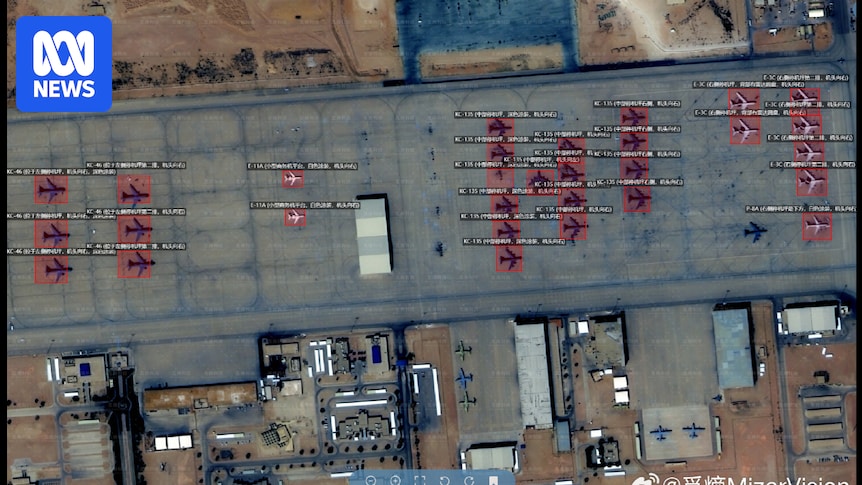
A Chinese company’s publication of AI-enhanced satellite images of US bases in the Middle East is helping Iranian forces identify targets, US intelligence believes.
The ABC has been briefed on the intelligence by a source inside US defence, who says the images are endangering lives.
Chinese geospatial artificial intelligence and software company MizarVision, which the Chinese government has a small ownership stake in, has been publishing detailed satellite images with tagging data of multiple US military sites in the lead-up to, and during, the Iran war.
The imagery showcases an AI tool that identifies and tags military forces across vast areas, a capability that once required the resources of a national intelligence agency.
Super-resolution as using generative models to “enhance” subresolution images with enough of the right training data?
Oh, that kind of super-resolution has been gaining media attention, but there’s much more beyond the “ai”. There are several mathematical methods, based on inverting a point-spread-function, statistical methods, super-resolution based on extracting subpixel information from a sequence of low resolution images, and several other methods and approaches, including the use of machine learning, but not in the generative way. It’s a very diverse and complex field of research
So basically DLSS for spy satellites. Kinda neat.
No, not exactly. More like how astrophotographers will stack images to compensate for imaging defects. After all, the Hubble was a variant of an NSA spy satellite.