

cross-posted from: https://mander.xyz/post/46558811
Like Xi Jinping’s appearance in Davos in 2017, Mark Carney’s speech in 2026 ultimately stood out less for its undeniable eloquence than for the distance between words and reality.
…
Just think back to January 2017, shortly after Donald Trump’s first inauguration, when Chinese Communist Party General Secretary Xi Jinping addressed the World Economic Forum in Davos. Speaking in his secondary role as president of the People’s Republic of China, Xi presented China as a defender of globalization, free trade, and the international order. The speech was a sensation. An audience still unsettled by Trump’s election greeted Xi’s remarks with enthusiasm. Media outlets around the world highlighted his warning that protectionism was like “locking oneself in a dark room without fresh air or sunlight.”
…
Later that same month, Xi told a closed-door meeting of China’s Central State Security Commission that China should assume what he called “dual leadership” (liang ge yindao): leadership of a “more just and rational new world order” and of a “new international security architecture.”
The State Security Commission, created in 2014 shortly after Xi consolidated power, reflects his governing instincts. It embodies an emphasis on comprehensive political and social control, enforced primarily through the Ministry of State Security (MSS) — China’s sprawling intelligence and internal security apparatus. In historical terms, the MSS resembles the KGB or East Germany’s Stasi, but with far greater technological reach and institutional capacity. Under Xi’s so-called “New Era,” this focus on security and control has steadily narrowed the space for Chinese citizens. If any society has locked itself into a dark room without light or fresh air, it is Xi’s China, rather than the United States under Trump’s first term.
…
Any hopes Davos elites may have harbored in 2017 about China as a defender of free trade soon looked grotesquely naïve. Since the 1990s, Beijing’s trade and industrial policy has been built on a thoroughly mercantilist model: maximizing exports and domestic production through heavy state intervention while suppressing imports and domestic consumption. Such approach does not promote free trade; it slowly kills it.
That contradiction became impossible to ignore during the COVID-19 pandemic and is now evident in China’s massive industrial overcapacity and chronic supply–demand imbalances, both at home and abroad. Enthusiasm for Beijing as a guarantor of free trade in Davos and elsewhere quickly cooled.
…
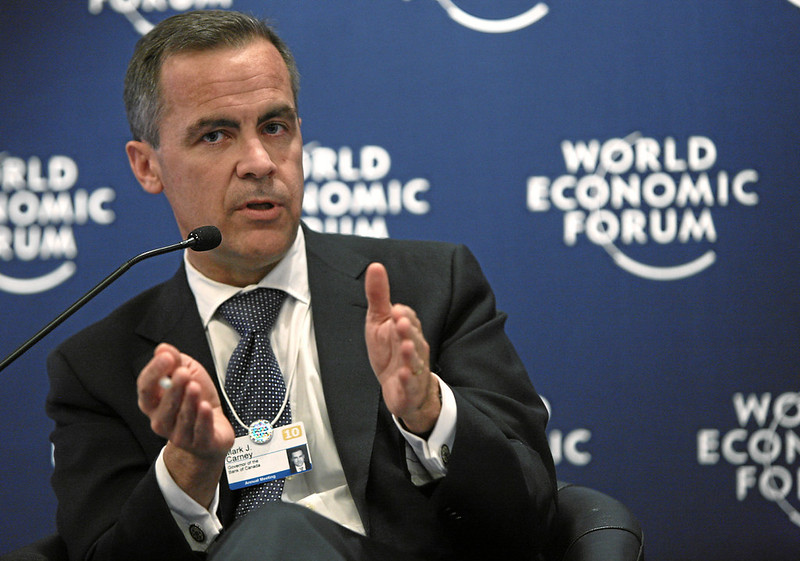
Nearly a decade later, history may not be repeating itself, but it certainly rhymes. Davos found a new hero to offset the shock of Trump. This time, the standing ovation was for Canadian Prime Minister Mark Carney.
In his address, Carney warned that the international order was coming apart and called on small states and middle powers to work together against the arrogance of great powers. Donald Trump, correctly inferring that he was the implied target, responded with characteristic bluster.
Carney’s call for collective action by smaller states against predatory great powers is, in principle, persuasive. In a world where rules are weakening, Europe in particular cannot rely on soft power alone. Greater internal cohesion and credible hard power matter too — a point driven home in Davos by Finnish President Alexander Stubb, among others.
…
As with Xi Jinping’s speech in 2017, however, Carney’s address — polished and articulate as it was — would have rung more true had it been matched by actual policy. In his actions, Carney has not tried to counter great-power arrogance by building a common front of smaller states. Instead, he has leaned toward one great power against another — and toward the consistently more problematic of the two.
Just a week before his appearance in Davos, Carney traveled to Beijing with considerable fanfare. There, he announced a “strategic partnership” with China and spoke of opening a “new era” in bilateral relations. Those relations had previously been strained by China’s arbitrary detention of two Canadian citizens in retaliation for Canada’s arrest of Huawei executive Meng Wanzhou, as well as by revelations of Chinese interference in Canadian democratic processes.
…
In Davos, Carney opened his speech with a quotation from Václav Havel’s The Power of the Powerless. Havel’s work continues to resonate for good reason. But the context suggested a deep misunderstanding of what Havel was arguing.
Equating the systematic repression of communist Czechoslovakia after 1968 with the postwar liberal order in the West is simply bizarre. Invoking Havel a week after accommodating a regime built on repression, coercion, and systematic untruth is hard to reconcile with the very idea of “living in truth.” It instead echoes the condition of “living a lie” that Havel set out to describe.
Like Xi Jinping’s appearance in Davos in 2017, Carney’s speech in 2026 ultimately stood out less for its undeniable eloquence than for the distance between words and reality. We will see how long the enthusiasm lasts in Davos this time.
…
As I recall it, he addressed this by saying that future agreements and deals would need to be more pragmatic, with partners that don’t necessarily share all their values. It sucks to have to make deals with the ccp, but that’s exactly the new order.
I only watched it once, though, so I could misremember.
It’s not the new order. You can make some sort of ‘tit-for-tat’ deals with China, but any strategic partnership with the CCP won’t benefit Canada nor any of China’s potential partners. Beijing will break any agreement as soon as it deems it appropriate (this is, for example, if you call for the release of foreign prisoners illegally detained in China, or if you support Taiwan’s independence, things like that). In the last decade, the CCP has even been increasing its games of political and economic coercion.
Canada needs to engage more with democratic states that share the same values. China’s autocratic system of repression - at home and abroad - as well as its economic policy based on mercantilism (China depends on ever expanding shares in foreign markets to sell its overcapacity) makes the country inherently unreliable.
From that point of view, Mr. Carney’s mistake was not necessarily his trip to Beijing, but rather the fact that he didn’t pass by before in Tokyo and Seoul, and in Canberra and Wellington.
[Edit typo.]
This is the nature of modern, post ww2 foreign policy.
If you see only absolute adherence to your country’s values as good and non-adherence as bad, you will end up in the terrible position of absolutist states like north Korea and Turkmenistan. In these places, leaders enjoy a good life and the average citizen has very few options beyond just existing miserably.
The world is not black and white and there is no such thing as a perfect trading partner.
Yeah, there would be no point in relying on China as a new favored trading partner, but as one among (hopefully) many, it could maybe work out. Absolutely agree that building stronger partnerships with liberal democracies should be the top priority, but I’m guessing some of the potential partners will need some time to go through the stages of grief…
ETA: scratching my head a bit over the up/downvote ratios of our comments, as I think we mostly agree.
I think there’s another bluntly-pragmatic angle:
Consider it dimension-by-dimension:
Trade ( 1 dimension, according to the “normal” view )
contrast that with:
Trade for expensive, high-value, high-markup things/svcs, what the upper-middle-class, financial-class, & upper-class can afford.
Trade for inexpensive, low-value things, what the working-poor can afford.
You CAN’T sell European appliances to people who can only afford cheap means.
For all the working-poor, price is the primary-decider of what they can afford.
Made in Japan often means … magnificently-right, but unaffordable, for many.
Unaffordable’s the same with Made in Europe.
That’s why the new Apple factory, in the US, was actually designed to be mostly-robots: it was the only way to make its products sellable for profit, into the market they’re targetting, while having the factory in the US.
They couldn’t employ people AND produce what they need to produce, for their market, so they designed it to not employ people.
I think people aren’t undstanding that there are different kinds of “market corrections”:
financial-correction, the “normal” kind, but also
re-orienting entire markets, when some delusion pops.
& I think they interact with each-other…
We’re in for BOTH kinds of them, in a month or so?
_ /\ _