

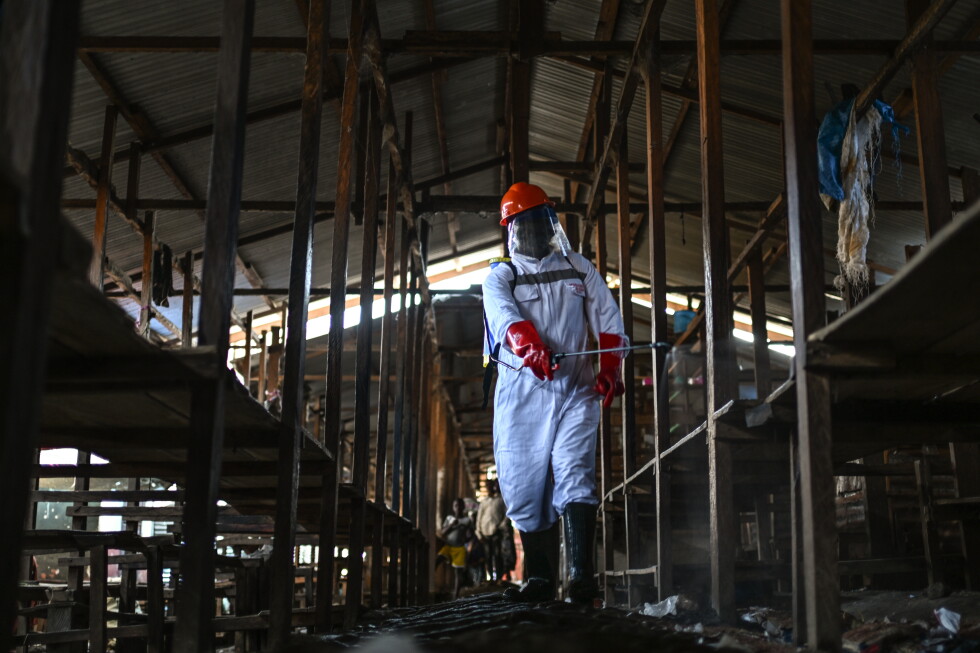
Residents of a town at the epicenter of the Ebola outbreak in eastern Congo attacked and burned part of a health center where people are being treated for the virus, and 18 people suspected of infection left the facility, a local hospital director said Saturday. It was the second such attack in the region in a week.
Unidentified people arrived at the clinic in Mongbwalu on Friday night and set fire to a tent set up for suspected and confirmed Ebola cases by the Doctors Without Borders humanitarian group, Dr. Richard Lokudi, director of the Mongbwalu General Reference Hospital, told The Associated Press.
So, symptoms of early stage ebola are fever, chills and tiredness - which happen to be the symptoms of much more common issues like malaria and pneumonia. So for the villagers (who, remember, have hundreds of years of generational trauma from both distant “authorities” and white people), someone gets sick, gets medical treatment but still dies - that’s just stuff that happens (many ebola cases don’t have unexplained bleeding or lesions). But a few days after the death, “authority” people in space suits show up, search the village and start forcibly moving anyone who’s sick into tents or other locations. They intrusively question who has had contact with the sick people, and they may get moved into quarantine as well. In a community where families care for the sick, the families and friends are prevented from seeing their loved ones. And then their loved ones just … disappear. They’re told that they died, but also that they can’t see, handle or bury the body.
This version of ebola has “only” about a 50% death rate, so half the people who get it simply disappear, and the people who are returned are weakened (sometimes severely) from their illness. But the people also have memories and rumors of other ebola strains, strains that killed over 90% of the people who got it.
Someone in the village gets sick and dies. Then the “authorities” show up and start kidnapping people, many of whom are never seen again. You can’t visit them, you can’t help them, you can’t even bury them - they’re just gone, taken by strangers, because that’s what strangers sometimes do. They tell you whatever weird things they’re doing are for your own good, but what they’re saying doesn’t make sense to you - and they’ve said that before and many times it hasn’t been.
Your community comes up with a reason for their actions that makes more sense to you, so that’s what you believe. So you attack the space-suited strangers when they try to kidnap more people, you burn down the building where they’re going to disappear people. Or if you’re in the US, you refuse to take a vaccine because it’s going to allow the government to track you, and if you feel sick you swallow bunches of horse paste and you defy orders not to go to church because it’s your town, your church, and you’ll be damned if you let those bastards in Washington break your community with some fake disease like covid.
Well written!
Seems plausible but isn’t meaning their asses shouldn’t be whooped.
This is a compelling story; sources?
I had immunocompromised family members. Back when covid hit, I spent about a year and a half mostly housebound - I couldn’t risk bringing something home. One of the things I did was to obsessively listen to a podcast called This Week In Virology; I even went back and listened to most of the 500+ episodes that they had already produced at the time. They had episodes where they talked about various aspects of ebola - how it’s spread, what the symptoms are, why some people can have such extremely paranoid and (to us) illogical reactions to the people who came in to treat the potentially infected, etc.
I remember someone explaining why some medical people had been murdered because of local distrust of the authorities; it didn’t make much sense to me at the time, but having seen how insane some of my own countrypeople got during covid, I don’t really have room to comment. I can’t point you to a specific episode, and I’m not going to re-listen to try to find it (each episode is 90-120 minutes), but it almost certainly was one of the ones tagged with ebola. I think it was one of the episodes with Alan Dove, though that doesn’t narrow it down much; and I think it probably wasn’t one of the Clinical Update episodes, which is probably more helpful.
I don’t recall all that other stuff happening during covid, like the government abducting a bunch of people and you couldn’t get the corpse back from the half of them that died…
You missed the transition from “ebola in Africa” in the first part of the paragraph to a parallel distrustful reaction in the US during covid. If it helps, that transition point is the part of the sentence that reads, “Or if you’re in the US”.
I didn’t miss it. I just think that while the parallels in outcomes exist, the parallels in justifications are completely absent.
I very much appreciated your original comment though. It helped contextualize the pushback in African countries against Ebola aid. But the pushback against pandemic measures in the US don’t make any sense to me, even after reading your comment.
In both cases people actively worked against health authorities, because they believed some delusions about the governments motive